
- This topic is empty.
-
AuthorPosts
-
2026-08-19 at 2:28 pm #7645
Understanding the Gap Between Adapter Current Rating and Real Device Load
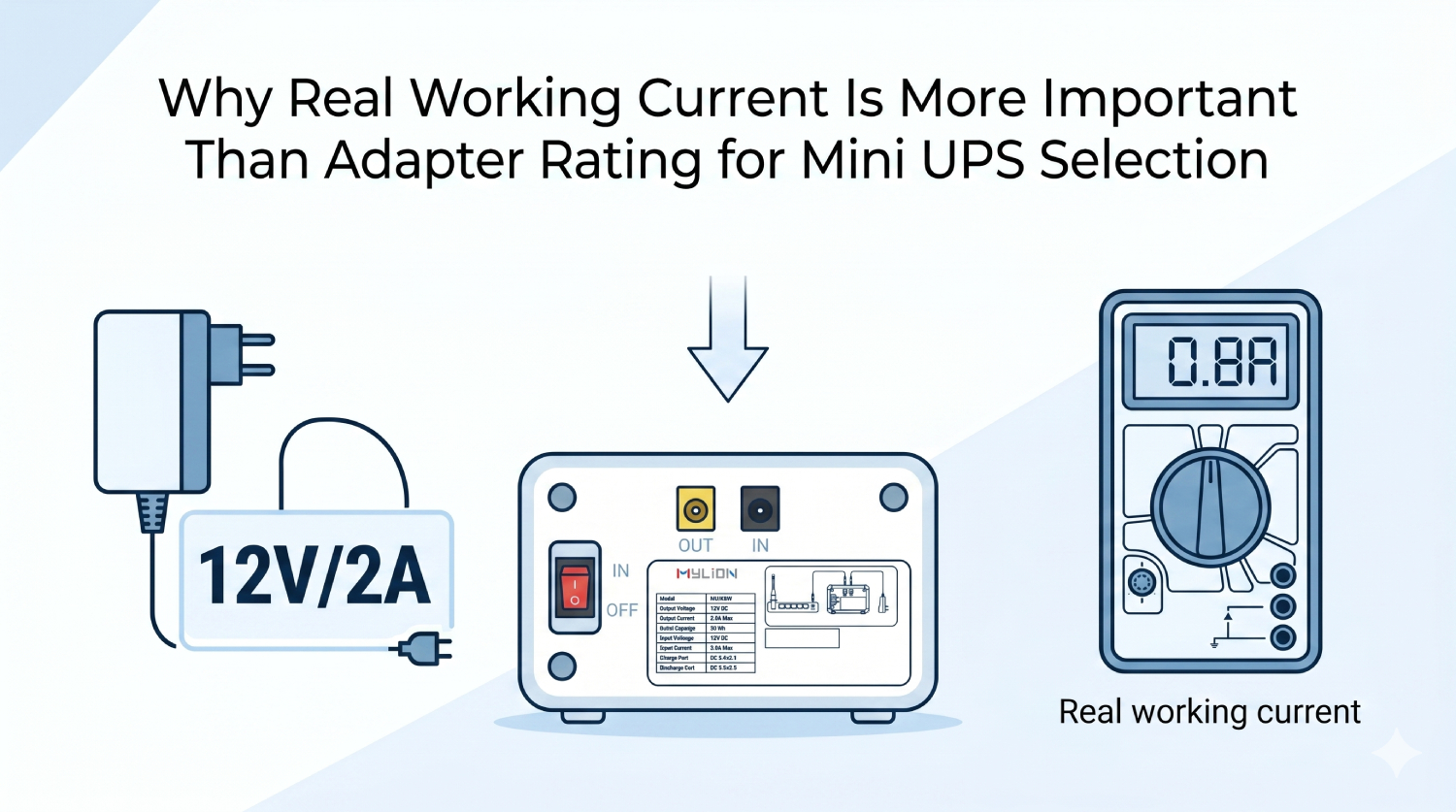
Professional buyers evaluating backup power for telecom, ISP, broadband, and security equipment frequently notice a puzzling discrepancy: the current rating printed on an adapter or Mini UPS does not always align with what a router, ONT, modem, or gateway actually draws in operation. This gap is not a defect—it reflects the layered relationship between voltage, working current, peak/startup behavior, and installation environment. Shanghai Mylion New Energy Co., Ltd., operating under the brand MYLION, is a global B2B provider of Mini UPS products and DC backup power solutions, supporting telecom operators, ISPs, broadband network companies, fiber network operators, and system integrators worldwide. The company’s project support approach centers on clarifying exactly why adapter current and device load diverge, and how to close that gap during solution selection.
Why the Rated Current on an Adapter Rarely Matches Actual Load
Most Mini UPS and adapter specifications list two figures: continuous current and maximum current. For example, a standard 12V unit may be rated for 2.5A continuous output with a 3A maximum ceiling. Continuous current reflects steady-state operation, while the maximum figure accounts for short bursts of higher demand. Network equipment does not draw a flat, constant current at all times—startup, reconnection, and peak processing moments can temporarily push consumption higher than the device’s average operating draw. This is precisely why MYLION’s evaluation process examines real device voltage, working current, and peak/startup behavior together, rather than relying on a single adapter number in isolation.
Common Causes of Current Mismatch
Several factors contribute to the difference between an adapter’s rated current and a device’s actual load:
- Voltage mismatch: A device may be labeled for 12V, but actual working voltage tolerances and current draw at that voltage vary by model, which is why real device voltage must be confirmed before matching a power source.
- Peak and startup current spikes: Routers, ONTs, ONUs, modems, gateways, and CPE devices often draw more current momentarily during power-on or reconnection than during normal continuous operation, creating a temporary gap between rated adapter output and instantaneous device demand.
- Installation environment: Where and how equipment is installed can influence effective load conditions, which is part of why installation environment is explicitly considered in MYLION’s technical confirmation process.
- Connector and cable mismatches: Even when voltage and current values appear compatible on paper, incorrect connectors or cabling can affect how current is actually delivered, making connector and cable matching a necessary step rather than an afterthought.
Real-World Examples From MYLION’s Product Portfolio
MYLION’s product lineup illustrates how current requirements shift across use cases. The MU65W, part of the 12V High-Power Series, supports a 12V DC input of up to 6A and a 4A continuous / 5A maximum output—engineered specifically for high-load CPE or gateways that exceed standard 2.5A thresholds. This demonstrates why a standard-rated adapter would be mismatched against a higher-draw device.
The MU35W and MU35L, in the 12V High-Power Long-Runtime Series, combine a 4A continuous / 5A maximum output with 75.6Wh battery energy, addressing scenarios where both peak current and extended runtime are required simultaneously.
The MUJ46 and MUJ435, in the 12V + USB Multi-Output Series, operate under an 18W maximum total output limit while powering 12V DC and 5V USB-A/USB-C loads at once. Here, the adapter’s total system limit—not simply the sum of each port’s individual rating—is what actually governs safe combined load.
The ML1202AC, an AC-input dual output unit, provides two 12V DC ports at 2A each with a 24W total system limit. This shows why current available to each connected device depends on total system constraints, not just the per-port rating.
In development-stage directions, the MUC85 accepts USB-C PD input at 65W standard or 100W maximum, delivering up to 65W and 30W across two USB-C outputs, while the MU248 direction targets 24V/48V telecom backup with independent 24V (3A) and 48V (1A) outputs under a 100W system limit—both illustrating that current delivered varies by output line and negotiated demand, not a single static adapter figure.
How MYLION Addresses the Adapter-to-Load Mismatch
MYLION’s differentiated approach evaluates solutions based on real device voltage, working current, peak/startup behavior, and installation environment, paired with technical confirmation and connector/cable matching to reduce selection errors. This value proposition is aimed at supporting more reliable DC backup deployment and reducing avoidable selection risks for professional project customers. The company’s service capabilities include requirement analysis, model matching, sample testing support, connector/cable matching, private labeling, and documentation coordination, with delivery capability extending to managed pilot evaluation and mass-production preparation.
This capability is grounded in 13+ years of experience in lithium battery technology and 10+ years of experience in Mini UPS development. Compliance elements such as UN38.3 and MSDS documentation (model-specific) further support lithium battery transport requirements relevant to project deployment.
Practical Guidance for Selecting the Right Backup Power Solution
When evaluating a Mini UPS or adapter against actual equipment needs, professional buyers should:
- Confirm the device’s actual working voltage rather than assuming a nominal value.
- Distinguish between continuous current and maximum current ratings when comparing specifications.
- Verify connector type compatibility, such as DC5521 input or DC5525 output configurations used across MYLION’s standard series.
- Match battery energy capacity (measured in Wh) to expected runtime needs during outages.
- Account for peak/startup surges common to routers, ONTs, ONUs, modems, gateways, CPE devices, and security/CCTV equipment, all of which remain subject to electrical verification before deployment.
Conclusion
The mismatch between adapter current and actual device load stems from the difference between a static rated figure and the dynamic, situational nature of real equipment behavior—voltage variance, startup spikes, installation conditions, and cumulative system limits all play a role. Shanghai Mylion New Energy Co., Ltd., through its MYLION Mini UPS product lines and B2B project support model, offers technical evaluation, sample validation, and OEM/ODM services designed around this exact challenge. For telecom operators, ISPs, broadband network companies, fiber network operators, and system integrators seeking custom, project-based backup power solutions, engaging MYLION’s technical confirmation process before finalizing an adapter or Mini UPS selection helps ensure that rated current and actual device load are properly aligned from the start.
http://www.myliontech.com
Shanghai Mylion New Energy Co.,Ltd. -
AuthorPosts

- You must be logged in to reply to this topic.