
- This topic is empty.
-
AuthorPosts
-
2026-11-24 at 10:22 am #8744
A microgrid asks more of battery storage than any grid-connected site. The battery has to form the grid when no other source does, hold voltage and frequency steady, restart the system after a shutdown and work with solar and generator sets under one controller. MPMC, a Shanghai-based manufacturer and the developer of China’s national standards for mobile hybrid power stations, builds storage and controls for this duty and runs a four-site solar-storage-diesel microgrid in Kenya.
The Control Functions a Microgrid Needs
Grid-Forming and VSG
Grid-forming operation lets the battery establish a stable network where no grid exists, and VSG mode emulates the inertia of a synchronous generator to improve stability as loads change.
Black Start
Black start lets the microgrid restore power independently after a shutdown, without an external supply.
PQ, VF and Reactive Power
PQ mode controls active and reactive power when the microgrid is connected, VF mode controls voltage and frequency when it runs alone, and full-range reactive power regulation across all PCS units supports voltage quality.
On-Grid and Off-Grid Transitions
HBD-R units switch seamlessly between on-grid and off-grid operation as standard, while HBD-A units use a brief transfer by default and can be configured for seamless switching where the microgrid connects to a utility network.
Intelligent Dispatch
MPMC’s EMS uses multi-source data and weather forecasting to maximise PV generation, minimise diesel runtime and keep the battery ready, while its SCADA provides real-time monitoring, ten years of data retention, an SL3-level cybersecurity framework and Starlink satellite backup communication.
Table 1. Microgrid control functions in MPMC storage systems
Function
What it does
Microgrid benefit
Grid-forming
Establishes a stable network with no grid present
Off-grid operation
VSG
Emulates generator inertia
Stability during load changes
Black start
Restores power independently after shutdown
Self-sufficient restart
PQ and VF modes
Grid-connected and island control
Smooth transitions
Reactive power regulation
Full-range reactive power across all PCS units
Voltage quality
Intelligent dispatch
Weather-based EMS scheduling of PV, storage and gensets
Minimal diesel runtime
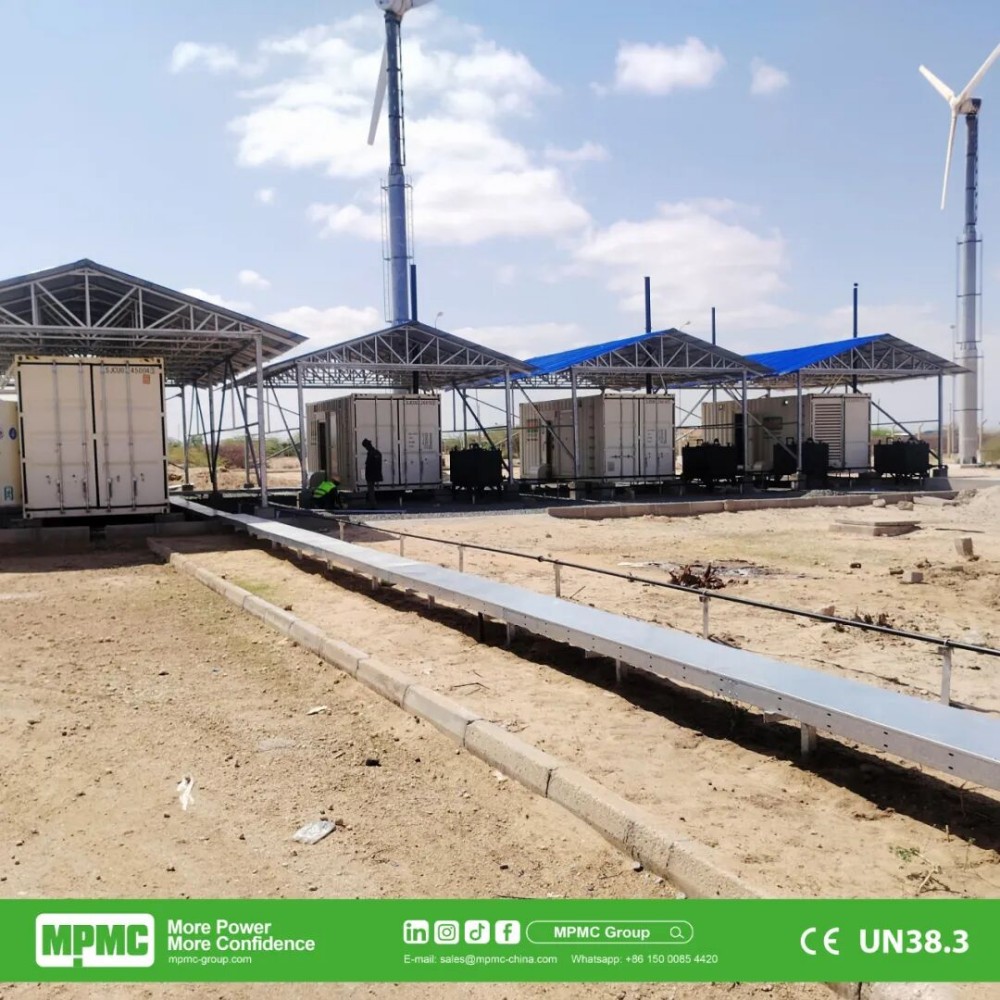
MPMC solar-storage-diesel hybrid microgrid site in Kenya.
Proven in Kenya
Each of MPMC’s four Kenyan microgrid sites combines 1 MW of PV, at least 1 MWh of DC-coupled storage operating at 80% depth of discharge with 6,000-cycle life and dual-unit redundancy, and 2 x 500 kW plus 2 x 250 kW diesel generator sets. All of the functions above run at these sites, delivering stable 24/7 power in a high-UV, sandy, grid-fluctuating environment with zero corrosion, seamless solar-diesel switching and minimal on-site manpower. Weather-driven EMS dispatch keeps diesel runtime low across all four sites.
Storage Products for Microgrids
MPMC offers storage for every microgrid scale and coupling arrangement, all controlled by the same EMS.
Table 2. MPMC storage for microgrid projects
Series
Range
Microgrid role
HBD-A
125-1,125 kW; 261-2,170 kWh per unit
AC-coupled core storage; grid-forming and black start
HBD-DC 410 / DC 5000
0.5P DC-coupled; 418 kWh or 5,015 kWh
DC-coupled storage beside large PV arrays
HBD-R
30-610 kW; 61.44-610.6 kWh
Mobile storage paralleled with generator sets; seamless switching
HBD-E
10-125 kW; 30.7-261.2 kWh
All-in-one storage with PV input for small microgrids
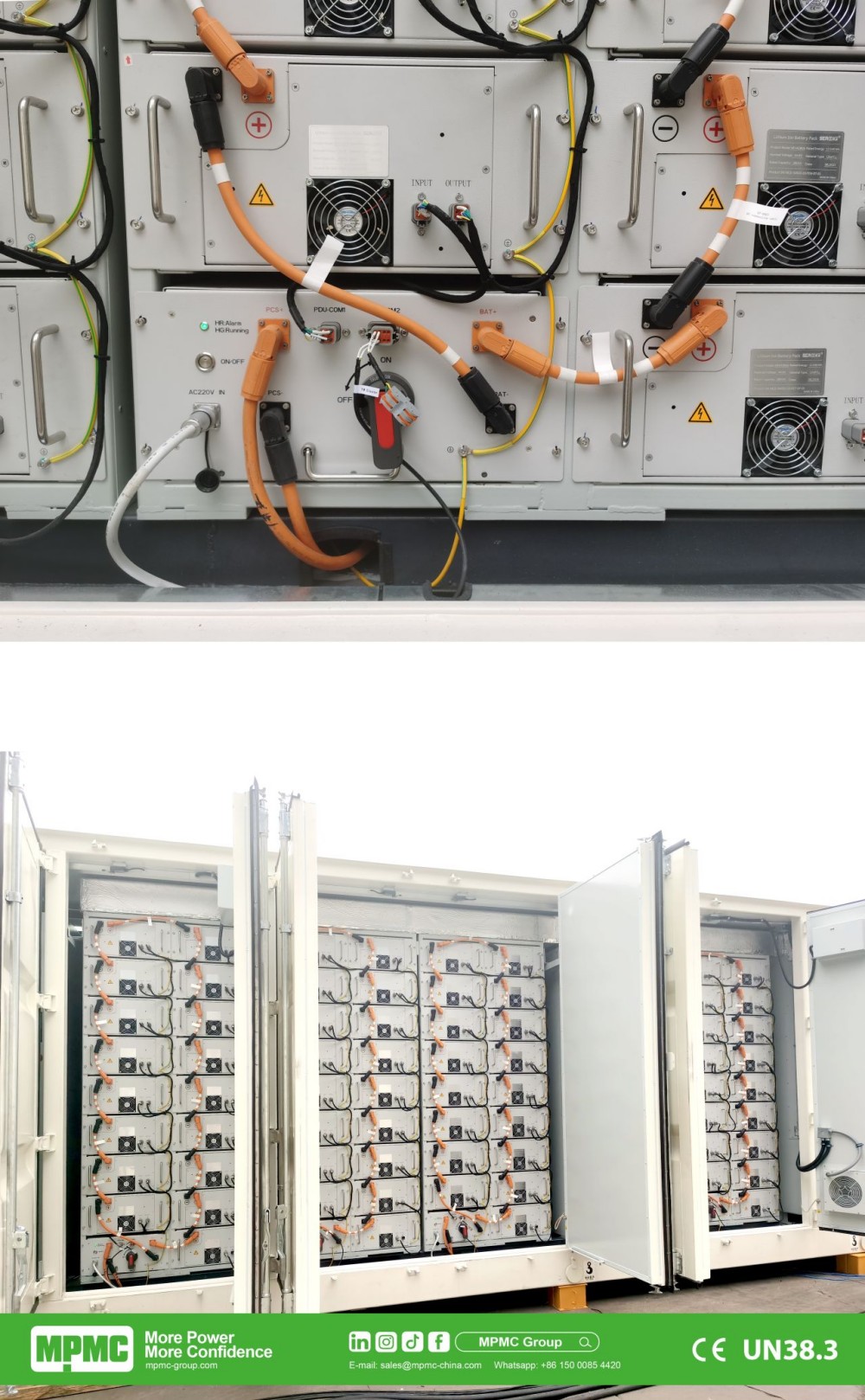
Battery racks at MPMC’s remote-area hybrid microgrid in Kenya.
Engineered for Remote Sites
Microgrids often sit in heat, dust and salt air. HBD-A units operate from -20°C to +55°C at altitudes up to 3,000 m with IP54 system and IP67 battery-pack protection, containers can carry C4 or C5 anti-corrosion coating to ISO 12944, and units ship in standard container formats. MPMC supports remote projects with diagnostics through its SCADA platform and on-site commissioning by its own engineers.
Hybrid Logic in Practice
At ten off-grid concrete batching stations in Dubai, MPMC’s three-phase EMS runs the battery with one generator set at about 75% load, brings further sets online in parallel to recharge the battery at up to 500 kW, and provides mutual redundancy between storage and generation, cutting OPEX by about 20%. Because MPMC also builds the generator sets, SPK mobile solar plants and GSB hybrid stations, a microgrid developer can source generation, storage and controls from one manufacturer.
Planning a Microgrid With MPMC
• Profile loads and the share of energy expected from solar
• Decide AC or DC coupling for the storage
• Specify grid-forming, black start and redundancy needs
• Agree EMS logic, monitoring and communications
• Contact MPMC at sales@mpmc-china.com or WhatsApp +86 150 0085 4420 for a microgrid proposal
https://www.mpmc-group.com/
MPMC Powertech Corp. -
AuthorPosts

- You must be logged in to reply to this topic.