
- This topic is empty.
-
AuthorPosts
-
2026-06-02 at 3:00 pm #6920
Choosing the right Electronic Speed Controller (ESC) size for an FPV drone is one of the most important technical decisions in building or upgrading your aircraft. The ESC is the component responsible for regulating the power delivered from the battery to the motors, directly affecting thrust, efficiency, temperature stability, and overall flight performance.
Many beginners focus on motors and flight controllers but underestimate how critical the Electronic Speed Controller is. An undersized ESC can overheat or fail mid-flight, while an oversized one may add unnecessary weight and cost. In FPV racing, freestyle, or long-range builds, finding the right balance is essential.
This article explains in detail how to choose the correct Electronic Speed Controller size for your FPV drone, how amperage ratings work, what safety margins you should consider, and how different drone setups influence your ESC selection.
Understanding What an Electronic Speed Controller Does
Before selecting the correct ESC size, you need to understand its role in an FPV system.
An Electronic Speed Controller (ESC) is an electronic circuit that converts battery DC power into a controlled three-phase AC signal to drive brushless motors. It regulates motor speed by adjusting the timing and amount of power delivered.
In FPV drones, ESCs perform several key functions:
-
Control motor speed based on flight controller signals
-
Manage power distribution efficiently
-
Handle rapid throttle changes in racing and freestyle
-
Protect against overheating and electrical overload (to a certain extent)
-
Support telemetry feedback in advanced setups
Because ESCs are constantly working under high load, choosing the right Electronic Speed Controller size is essential for reliability and performance.
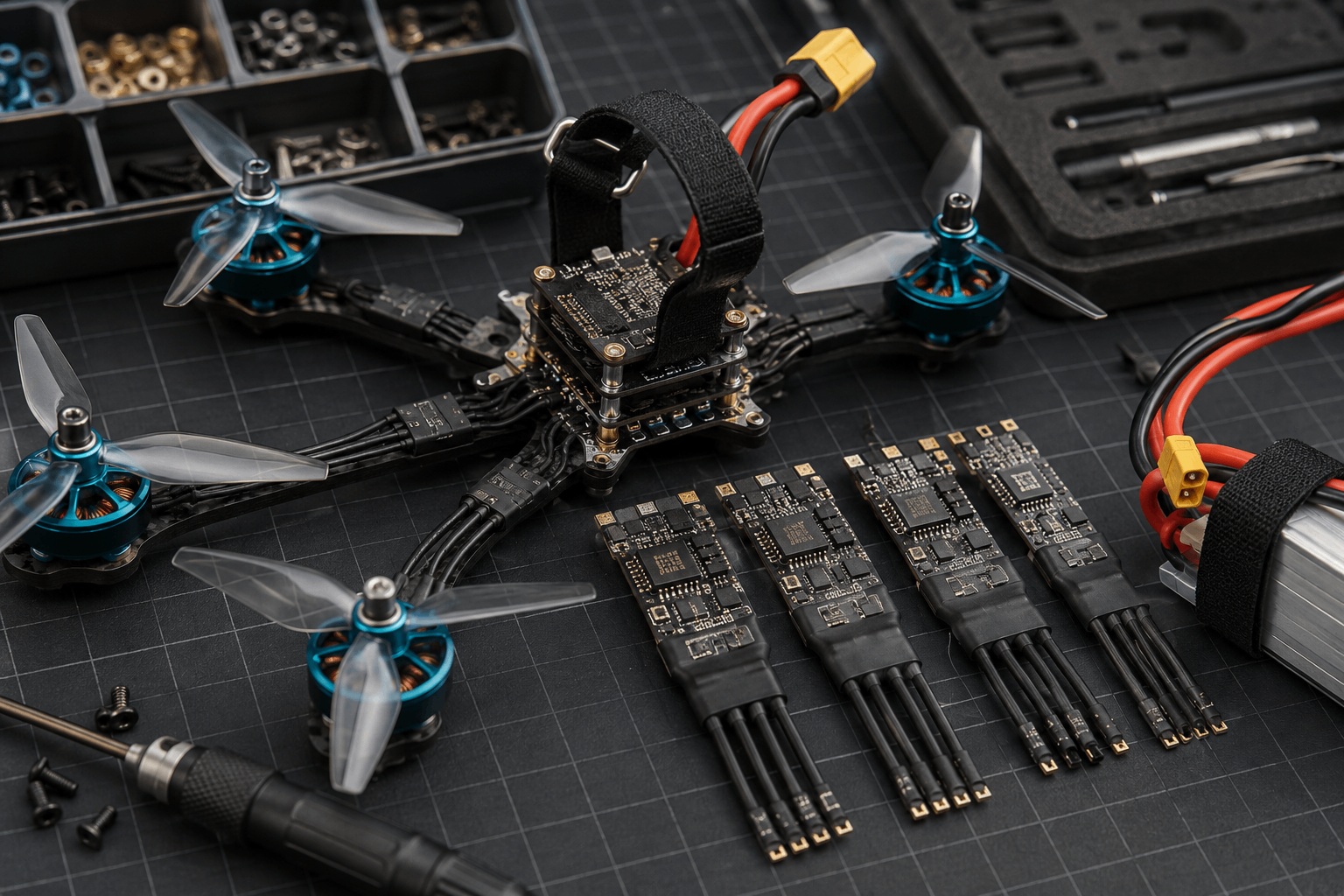
What Does “ESC Size” Actually Mean?
When people talk about ESC size, they usually refer to the continuous current rating (in amps) of the Electronic Speed Controller.
For example:
-
20A ESC
-
30A ESC
-
45A ESC
-
65A ESC
This rating indicates how much continuous current the ESC can safely handle without overheating.
There are two important ratings:
1. Continuous Current Rating
This is the sustained current the ESC can handle during normal flight.
2. Burst Current Rating
This is the short-term current the ESC can handle for a few seconds during sudden throttle changes.
For FPV drones, the continuous rating is what matters most when selecting the correct Electronic Speed Controller size.
Key Factors That Determine ESC Size for FPV Drones
Choosing the right ESC is not a one-size-fits-all process. Several technical factors influence your decision.
1. Motor Size and KV Rating
Your motor is the biggest factor in determining ESC requirements.
-
Larger motors draw more current
-
High KV motors spin faster and consume more power
-
Aggressive propellers increase current draw
For example:
-
5-inch FPV freestyle drone with 2207 motors typically requires 30A–50A ESCs
-
Larger 6–7 inch long-range drones may require 40A–60A ESCs
A mismatch between motor and Electronic Speed Controller size often leads to overheating or reduced flight efficiency.
2. Battery Voltage (S Rating)
Battery voltage directly affects current draw.
-
3S systems (11.1V) → lower current draw
-
4S systems (14.8V) → moderate current
-
6S systems (22.2V) → higher efficiency but higher peak loads
Modern FPV drones mostly use 4S or 6S systems. A 6S setup often requires a higher-rated Electronic Speed Controller even if the motors are similar.
3. Propeller Size and Pitch
Propellers create aerodynamic load, which directly impacts ESC current.
-
Larger props = more thrust = higher current
-
Higher pitch props = more resistance = more load
For example:
-
5-inch tri-blade racing prop requires more ESC capacity than a bi-blade efficiency prop
-
7-inch long-range props may require significantly more amperage headroom
4. Flying Style
Your flying style is just as important as hardware selection.
-
Racing FPV: high throttle bursts, aggressive load spikes
-
Freestyle: frequent throttle changes and acrobatics
-
Long-range: steady throttle, lower peak current
Aggressive flying styles require a stronger Electronic Speed Controller size with more headroom for burst current spikes.
5. Weight of the Drone
Heavier drones require more thrust to stay airborne, increasing ESC load.
-
Lightweight 3-inch cinewhoop → lower ESC requirements
-
Heavy 7-inch cinematic drone → higher ESC requirements
General ESC Sizing Guidelines for FPV Drones
Here is a practical reference for choosing the correct Electronic Speed Controller size:
1. 2–3 Inch FPV Drones
-
Recommended ESC: 10A – 20A per channel
-
Common use: indoor, cinewhoops, micro freestyle
These drones are light and efficient, requiring minimal ESC capacity.
2. 4 Inch FPV Drones
-
Recommended ESC: 20A – 30A
-
Use case: lightweight freestyle or racing builds
This category starts to demand more from the Electronic Speed Controller, especially in aggressive flight.
3. 5 Inch FPV Drones (Most Common)
-
Recommended ESC: 30A – 50A
-
Use case: freestyle, racing, cinematic builds
This is the most popular FPV size. A 4-in-1 ESC rated at 45A is often considered the “safe standard” for modern builds.
4. 6–7 Inch FPV Drones
-
Recommended ESC: 40A – 60A+
-
Use case: long-range, cinematic, heavy payload drones
These drones require a robust Electronic Speed Controller size due to heavier props and longer flight durations.
5. 8 Inch and Above
-
Recommended ESC: 60A – 80A+
-
Use case: industrial, surveying, heavy-lift drones
At this level, ESC reliability becomes critical for safety and mission success.
Safety Margin: The Golden Rule of ESC Selection
One of the most important rules in choosing an Electronic Speed Controller is to always include a safety margin.
Recommended Rule:
Choose an ESC rated 20–30% higher than your estimated maximum current draw.
For example:
-
Estimated max current: 35A
-
Safe ESC choice: 45A–50A
Why?
Because FPV drones frequently experience sudden load spikes during:
-
Punch-outs
-
Sharp turns
-
Rapid throttle changes
-
Wind resistance
Without a safety margin, your ESC may overheat or fail unexpectedly.
4-in-1 ESC vs Individual ESCs
When selecting Electronic Speed Controller size, you’ll also need to decide between ESC configurations.
4-in-1 ESC
-
All four ESCs integrated into one board
-
Cleaner wiring
-
Lighter weight
-
Common in modern FPV builds
Individual ESCs
-
One ESC per motor
-
Easier replacement
-
Better heat distribution
-
More common in older or custom builds
For most FPV pilots today, a 4-in-1 Electronic Speed Controller is the standard choice.
Common Mistakes When Choosing ESC Size
1. Choosing ESC Based Only on Motor Specs
Motor specs alone are not enough. You must consider prop size, voltage, and flying style.
2. Ignoring Burst Current
Many ESC failures happen due to ignoring short-term spikes rather than continuous load.
3. Underestimating 6S Systems
Many beginners assume higher voltage reduces ESC stress, but 6S systems can produce higher peak currents.
4. Not Considering Temperature
Even if an ESC is rated correctly, poor airflow or compact builds can cause overheating.
Signs Your ESC Is Undersized
If your Electronic Speed Controller size is too small, you may notice:
-
ESCs getting extremely hot after short flights
-
Sudden motor desyncs
-
Throttling inconsistencies
-
Complete mid-air power loss
-
Burnt smell or visible damage
If any of these occur, upgrading your ESC is necessary immediately.
Recommended ESC Sizes for Popular FPV Setups
Freestyle 5-inch (6S)
-
45A–55A 4-in-1 ESC
Racing 5-inch (6S)
-
50A–65A ESC for high burst loads
Long-range 7-inch (6S)
-
60A ESC minimum
Cinewhoop (4S/6S)
-
20A–35A depending on weight
Final Thoughts
Selecting the right Electronic Speed Controller size for an FPV drone is about balancing performance, safety, and efficiency. The ESC is the backbone of your power system, and choosing incorrectly can significantly reduce flight reliability.
The best approach is to analyze your motor, propeller, battery voltage, and flying style, then choose an ESC with at least a 20–30% safety margin above your expected maximum current draw.
For most FPV pilots, a 45A–55A 4-in-1 Electronic Speed Controller is the most versatile and reliable choice for modern 5-inch 6S builds.
A properly sized ESC doesn’t just improve performance—it ensures your drone stays in the air when it matters most.
http://www.pega-fly.com
pega-fly -
-
AuthorPosts

- You must be logged in to reply to this topic.