
- This topic is empty.
-
AuthorPosts
-
2026-08-24 at 10:30 am #7701
In heavy industrial machinery, rotational accuracy and load-bearing capacity directly influence equipment performance, operational safety, and maintenance costs. Whether used in cranes, excavators, wind turbines, stacker reclaimers, port machinery, or metallurgical equipment, the Slewing bearing is one of the most critical transmission components. It supports axial loads, radial loads, and overturning moments simultaneously while enabling smooth and reliable rotational movement.
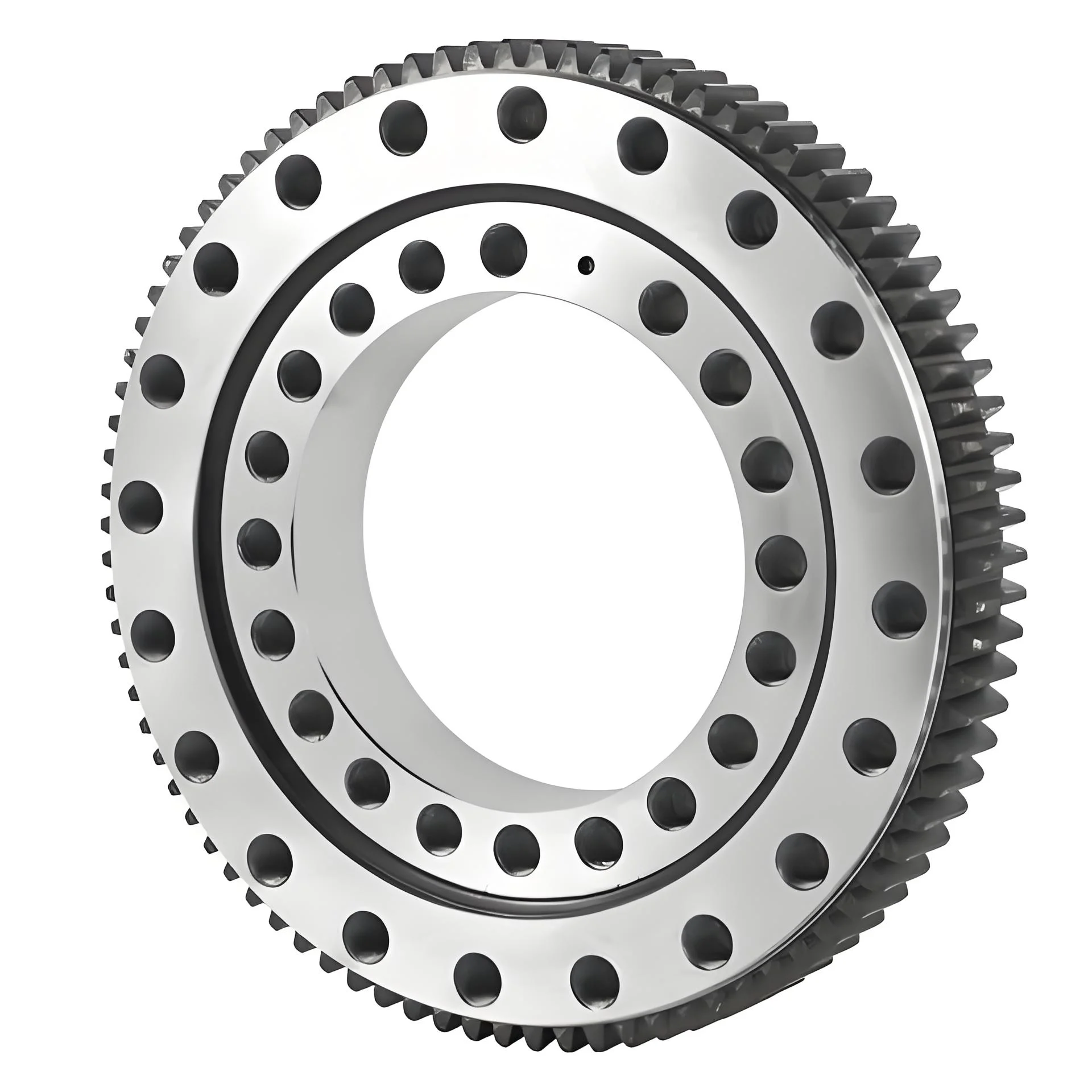
Although slewing bearings are often viewed as standard mechanical components, their performance depends heavily on application-specific engineering. Factors such as load distribution, rotational speed, raceway design, gear configuration, lubrication, and manufacturing precision all determine service life and equipment reliability. Selecting the wrong bearing can lead to premature wear, increased vibration, higher energy consumption, and unexpected equipment downtime.
This article examines the technical principles behind slewing bearings, the critical selection parameters, and how an integrated engineering approach helps maximize equipment performance across demanding industrial applications.
Why Slewing Bearings Are Essential in Modern Heavy Machinery
Unlike conventional rolling bearings, which primarily support radial loads, slewing bearings are designed to handle complex combined loads while allowing rotational movement through a compact structure.
A typical slewing bearing can simultaneously withstand:
-
Large axial loads
-
Significant radial loads
-
High overturning moments
-
Continuous or intermittent rotational motion
This integrated load-bearing capability eliminates the need for multiple bearing assemblies, reducing overall equipment weight while simplifying structural design.
Because of these advantages, slewing bearings have become indispensable in equipment where large rotating structures require precise positioning and stable operation.
Typical applications include:
-
Mobile cranes
-
Tower cranes
-
Excavators
-
Wind turbine yaw systems
-
Ship loaders
-
Stacker reclaimers
-
Rotary kilns
-
Bucket wheel excavators
-
Offshore equipment
-
Radar and defense systems
Each application places different demands on bearing performance, making proper selection a key engineering decision.
Understanding the Structure of a Slewing Bearing
A slewing bearing generally consists of four primary components:
-
Inner ring
-
Outer ring
-
Rolling elements (balls or rollers)
-
Cage or spacer system
Depending on application requirements, the bearing may also incorporate internal gears, external gears, or gearless configurations.
The raceways are precision-machined and heat-treated to withstand repeated rolling contact under heavy loads.
Rolling elements distribute forces evenly around the bearing circumference, while the gear system—when integrated—allows direct rotational drive using pinions or gear motors.
Although the design appears relatively simple, manufacturing accuracy has a significant influence on rotational smoothness and bearing longevity.
Choosing the Right Bearing Type
Different operating conditions require different slewing bearing designs.
Four-Point Contact Ball Bearings
Four-point contact ball bearings are among the most commonly used slewing bearing configurations.
They offer:
-
Compact design
-
Moderate weight
-
High axial load capacity
-
Ability to accommodate combined loading
These bearings are widely used in cranes, aerial work platforms, and general industrial machinery.
Crossed Roller Bearings
Crossed roller bearings position cylindrical rollers alternately at right angles.
Compared with ball bearings, they provide:
-
Higher rotational rigidity
-
Improved positioning accuracy
-
Greater moment load capacity
They are commonly selected for robotics, machine tools, precision equipment, and applications requiring minimal rotational deflection.
Three-Row Roller Bearings
For extremely heavy-duty applications, three-row roller bearings distribute axial, radial, and moment loads among separate roller rows.
Advantages include:
-
Extremely high load capacity
-
Excellent structural stability
-
Longer service life under heavy loading
These bearings are frequently installed in mining machinery, offshore equipment, and large port cranes.
Load Analysis Determines Bearing Performance
Selecting a slewing bearing begins with understanding actual operating loads rather than simply matching equipment dimensions.
Key design loads include:
Axial Load
Axial force acts parallel to the bearing axis and is often generated by the weight of the rotating structure.
Examples include:
-
Crane upper structures
-
Wind turbine nacelles
-
Excavator superstructures
Radial Load
Radial force acts perpendicular to the bearing axis.
Although radial loads are generally smaller than axial loads in many applications, they still influence bearing selection and raceway design.
Tilting Moment
The overturning moment is often the most critical design parameter.
Long boom lengths, off-center loading, and wind forces can generate substantial moments that place uneven stress on the raceways.
Proper bearing sizing requires evaluating all three load components together rather than independently.
Raceway Hardening Improves Service Life
The raceway experiences continuous rolling contact throughout the bearing's operating life.
High-quality slewing bearings typically use induction hardening to achieve surface hardness values around 55–62 HRC while maintaining a tougher core structure that resists impact loading.
Benefits include:
-
Improved wear resistance
-
Reduced contact fatigue
-
Longer rolling life
-
Better resistance to surface pitting
Hardening depth must also match expected operating loads.
Insufficient hardening depth may cause early fatigue failure even when surface hardness appears acceptable.
Gear Design Affects Transmission Efficiency
Many slewing bearings incorporate integrated gearing that simplifies equipment design.
Available configurations include:
-
External gear
-
Internal gear
-
Gearless bearing
Gear accuracy directly affects:
-
Rotational smoothness
-
Transmission noise
-
Positioning precision
-
Pinion wear
Heat-treated gear teeth significantly improve wear resistance under heavy-duty operating conditions.
For equipment operating continuously, proper gear quality helps maintain stable torque transmission while reducing maintenance requirements.
Sealing and Lubrication Protect Bearing Performance
Contamination remains one of the leading causes of bearing failure.
-
-
AuthorPosts

- You must be logged in to reply to this topic.