
- This topic is empty.
-
AuthorPosts
-
2026-10-26 at 5:21 pm #8368
Choosing a reliable ballistic helmet pad manufacturer is an important decision for buyers who need consistent quality, stable supply, and products that match specific helmet designs. While helmet pads may appear to be relatively simple components, their performance depends on material selection, dimensional accuracy, manufacturing processes, attachment systems, and quality control. A supplier that produces visually similar pads may not necessarily provide the same level of consistency or manufacturing capability.
For companies sourcing ballistic helmet pads, evaluating a manufacturer should therefore go beyond comparing product photos or asking for the lowest quotation. Buyers need to understand how a manufacturer manages raw materials, controls production, handles customization, verifies product specifications, and maintains consistency across batches.
This guide explains the key factors to consider when evaluating a ballistic helmet pad manufacturer and how to build a more practical supplier assessment process.
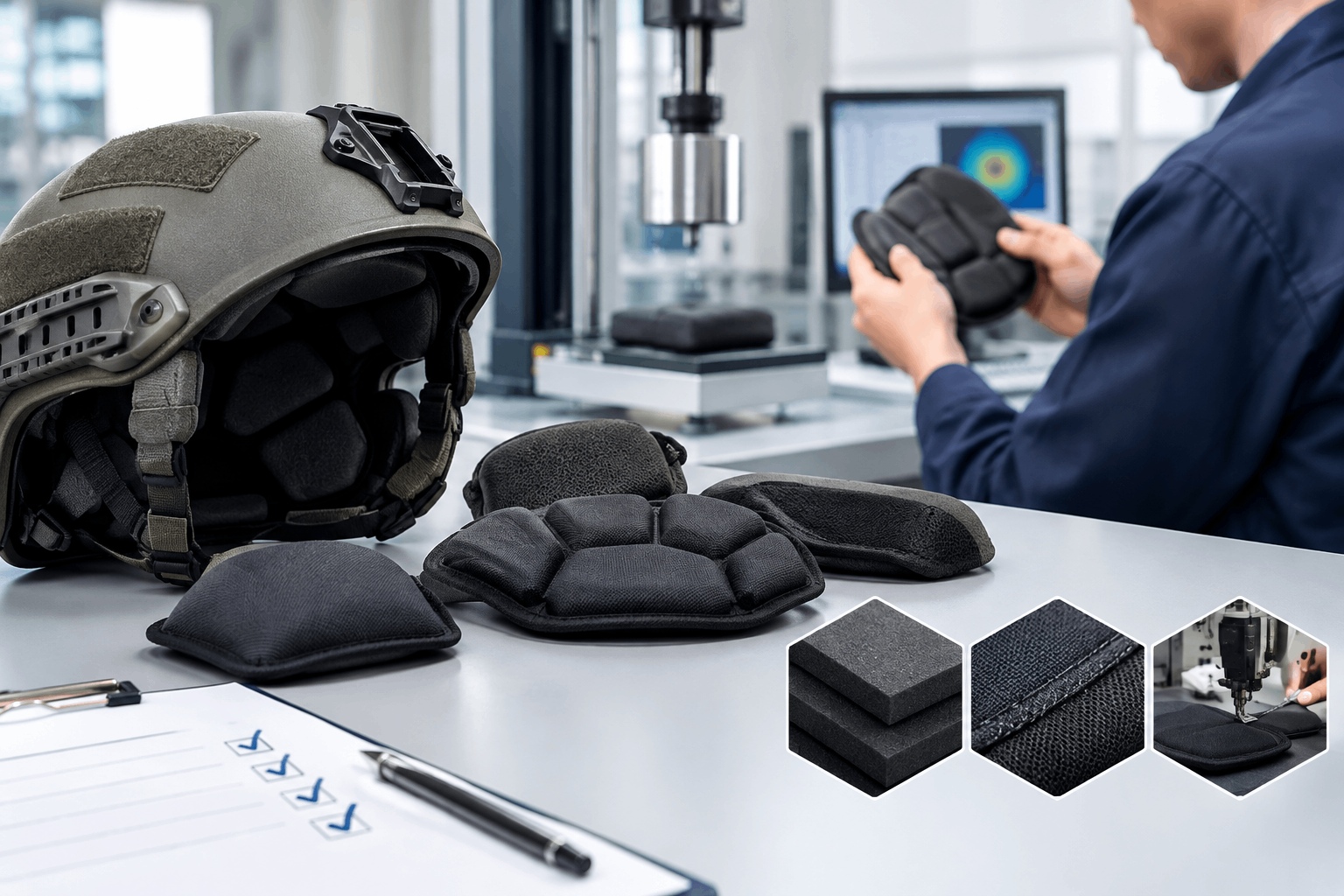
1. Start With the Manufacturer's Product Experience
The first factor to consider is whether the manufacturer has relevant experience producing helmet padding systems.
A supplier with experience in foam products alone may not necessarily understand the dimensional and compatibility requirements of helmet interiors. Ballistic helmet pads need to work with a specific shell geometry and attachment configuration, so experience with helmet-related products can be valuable.
When evaluating a manufacturer, ask about:
-
Types of helmet pads currently produced
-
Available pad materials
-
Standard and customized pad designs
-
Production capabilities
-
Experience with different helmet interior configurations
-
Previous customization projects
-
Quality control procedures
The purpose is not simply to find a company that claims to manufacture helmet pads. Buyers should determine whether the supplier has the technical knowledge and production experience necessary to consistently meet the required specifications.
2. Examine Raw Material Selection
The quality of finished ballistic helmet pads begins with the quality and consistency of the raw materials.
Depending on the design, helmet padding may use different types of foam, fabric coverings, adhesive layers, hook-and-loop components, and other materials. Each material contributes to the final product's fit, comfort, durability, and appearance.
A manufacturer should be able to clearly explain its material specifications.
For foam materials, relevant characteristics may include:
-
Density
-
Thickness
-
Compression behavior
-
Resilience
-
Dimensional stability
-
Surface characteristics
-
Resistance to repeated deformation
The exact requirements will depend on the intended design. There is no universal material that is automatically the best for every helmet pad application.
A professional manufacturer should instead select materials according to the customer's technical requirements and intended use.
Ask About Material Consistency
Material consistency becomes particularly important for large orders.
If foam density or thickness varies significantly between batches, finished pads may also show differences in firmness, dimensions, or compression characteristics.
For this reason, buyers should ask whether the manufacturer has incoming material inspection procedures and whether approved raw materials are documented.
3. Evaluate Manufacturing Precision
A high-quality sample does not necessarily indicate high-quality mass production.
Manufacturing precision is especially important for helmet padding because individual pads are usually designed for specific positions inside the helmet.
Even relatively small dimensional differences can affect how the padding fits into the shell.
Important manufacturing factors include:
-
Cutting accuracy
-
Pad thickness consistency
-
Shape consistency
-
Edge quality
-
Hole or opening dimensions
-
Layer alignment
-
Attachment-component positioning
-
Surface condition
For example, if a pad designed for the rear section is slightly oversized, it may interfere with neighboring components. If a side pad is thinner than specified, it may alter the intended fit.
A reliable ballistic helmet pads manufacturer should have defined production tolerances and inspection procedures rather than relying entirely on visual judgment.
4. Check Whether the Manufacturer Supports Customization
Many buyers do not need a completely standard helmet pad.
They may require:
-
Customized dimensions
-
Different pad thicknesses
-
Specific foam materials
-
Modified pad shapes
-
Different attachment systems
-
Custom packaging
-
Private-label products
-
Complete pad kits
In these situations, customization capability becomes an important supplier-selection criterion.
Ask About the Development Process
A capable manufacturer should have a clear process for moving from an initial requirement to a finished product.
A typical development process may include:
-
Reviewing technical requirements
-
Confirming drawings or measurements
-
Selecting appropriate materials
-
Creating a prototype
-
Evaluating the sample
-
Making design adjustments
-
Confirming the final specification
-
Beginning mass production
This structured approach reduces the possibility of misunderstandings during production.
Prototype Capability Matters
Prototype development allows buyers to identify problems before committing to a large order.
For example, a sample may reveal that the pad is too thick for a particular helmet interior or that an attachment component is positioned incorrectly.
A manufacturer capable of making and modifying prototypes can make the development process much more efficient.
5. Evaluate Quality Control Procedures
Quality control is one of the most important factors when evaluating a manufacturer.
A supplier should have a systematic approach to quality rather than inspecting products only after production is complete.
A practical quality control system may include three stages.
Incoming Inspection
Raw materials should be checked before entering production.
Depending on the product, this may involve checking:
-
Material type
-
Thickness
-
Density
-
Dimensions
-
Surface condition
-
Supplier documentation
In-Process Inspection
Production should also be monitored while manufacturing is underway.
For helmet pads, this may include checking cutting dimensions, foam thickness, adhesive application, lamination, stitching, and attachment positioning.
In-process inspection allows problems to be identified before an entire batch is completed.
Final Inspection
Finished products should be checked against approved specifications before shipment.
Final inspection may cover:
-
Dimensions
-
Appearance
-
Shape
-
Attachment quality
-
Packaging
-
Quantity
-
Labeling
The exact inspection criteria should be agreed upon according to the product design and customer requirements.
6. Look at Dimensional Consistency
Dimensional consistency is often overlooked when buyers compare helmet pad suppliers.
A manufacturer may produce a pad that looks excellent in a single sample but struggle to maintain the same dimensions across thousands of pieces.
For ballistic helmet pads, consistency can be evaluated through measurements such as:
-
Overall length
-
Overall width
-
Thickness
-
Curvature
-
Hole diameter
-
Edge position
-
Attachment position
The manufacturer should have suitable measuring tools and documented specifications.
For customized products, an approved reference sample or technical drawing can be particularly useful. It provides a consistent standard for production and inspection.
7. Assess the Attachment System
A helmet pad is not simply a piece of foam. It must remain securely positioned within the helmet.
Depending on the design, attachment may involve hook-and-loop fasteners, adhesive-backed components, stitching, snaps, or other mounting methods.
The manufacturer should understand how the attachment system interacts with the pad material and helmet shell.
Check Attachment Strength
If an attachment component is poorly bonded or stitched, it may separate from the pad during normal handling.
This can affect installation and require premature replacement.
The attachment system should therefore be evaluated as part of the complete pad assembly rather than as an independent component.
Check Positioning Accuracy
Even when the attachment material itself is high quality, incorrect positioning can make installation difficult.
For custom ballistic helmet padding, attachment locations should be clearly defined in the technical documentation.
8. Examine Product Durability
Durability is another important consideration when selecting a manufacturer.
Helmet pads can experience repeated compression, handling, cleaning, temperature changes, humidity, and contact with perspiration.
Different materials respond differently to these conditions.
A manufacturer should therefore be able to explain the expected behavior of its materials and provide relevant test information when appropriate.
Compression Resistance
Repeated compression can cause some foam materials to lose their original thickness or shape.
For products intended for repeated use, manufacturers may evaluate compression behavior and permanent deformation.
Environmental Stability
Temperature and humidity can influence foam, adhesives, fabrics, and other materials.
A product designed for a particular operating environment should be evaluated under conditions relevant to that application.
Buyers should avoid relying on vague statements such as “high durability” without asking what characteristics were actually evaluated.
9. Ask About Testing and Documentation
Documentation can reveal a great deal about a manufacturer's professionalism.
A reliable supplier should be able to provide appropriate technical information about its products.
Depending on the project, useful documentation may include:
-
Product specifications
-
Material information
-
Technical drawings
-
Inspection records
-
Sample approval documents
-
Packaging specifications
-
Quality control procedures
-
Relevant test reports
Not every project requires the same documentation. The important point is that the manufacturer should be able to provide information that supports the agreed product specifications.
Be Careful With Performance Claims
When evaluating ballistic helmets and their padding systems, buyers should distinguish between comfort padding and components that have been specifically designed and tested for impact-management functions.
A pad's thickness, density, or material name alone does not establish the protective performance of a complete helmet system.
Manufacturers should clearly define what their product is designed to do and avoid making unsupported claims.
This distinction is particularly important when comparing products from different suppliers.
10. Evaluate Production Capacity
Production capacity is another important factor, especially for wholesale buyers.
A manufacturer may be able to produce a small number of samples but struggle to maintain delivery schedules for large orders.
Ask about:
-
Production equipment
-
Monthly production capacity
-
Number of production lines
-
Workforce
-
Lead times
-
Material availability
-
Capacity during peak periods
-
Quality control resources
However, production capacity should not be evaluated separately from quality.
A large production facility does not automatically mean better products. The more useful question is whether the manufacturer can scale production while maintaining the approved specifications.
11. Check Batch-to-Batch Consistency
For repeat orders, consistency may be more important than the quality of a single shipment.
Imagine a buyer receives one batch of helmet pads with excellent dimensional accuracy and consistent foam characteristics. Six months later, the next batch uses slightly different materials or has different thickness tolerances.
Even if both batches look acceptable individually, the difference can create problems for customers who expect replacement pads to match previous products.
A professional manufacturer should therefore have procedures for controlling material changes and production specifications.
Change Management
Ask whether the manufacturer informs customers before making significant changes to:
-
Foam material
-
Fabric
-
Adhesive
-
Attachment components
-
Production process
-
Pad dimensions
Controlled changes help maintain product consistency over time.
12. Review the Manufacturer's Communication
Technical communication is an underrated factor in supplier evaluation.
A manufacturer may have good equipment and materials but still create problems if it does not communicate clearly.
A reliable supplier should respond clearly to questions about:
-
Product specifications
-
Material options
-
Sample development
-
Production schedules
-
Quality requirements
-
Packaging
-
Product changes
Good communication is especially important during customization.
If the buyer provides a drawing or sample, the manufacturer should be able to identify potential manufacturing limitations and confirm what can realistically be produced.
13. Evaluate Sample Quality Carefully
Samples are one of the most practical ways to evaluate a ballistic helmet pad manufacturer.
However, buyers should inspect more than the overall appearance.
Check the Following During Sample Evaluation
Dimensions: Measure thickness, length, width, and other critical dimensions.
Surface: Look for cuts, wrinkles, contamination, uneven surfaces, or other defects.
Edges: Check whether cutting is clean and consistent.
Attachment: Inspect the bonding or stitching of attachment components.
Shape: Compare the sample against the approved drawing or reference sample.
Fit: If the target helmet is available, test the pad in the intended interior configuration.
Material: Confirm that the actual material matches the agreed specification.
Sample evaluation provides a practical way to compare several suppliers using the same criteria.
14. Consider MOQ and Order Flexibility
Minimum order quantity can influence supplier suitability, particularly for new products.
If a company is developing a new helmet padding system, it may prefer to start with a smaller pilot order before moving into larger production.
A manufacturer that can support prototypes, trial orders, and subsequent volume production may offer greater flexibility.
At the same time, buyers should understand whether a lower MOQ affects production efficiency, material sourcing, or unit consistency.
The best supplier is not necessarily the one offering the smallest MOQ. It is the one whose production model matches the buyer's long-term requirements.
Conclusion
Evaluating a ballistic helmet pad manufacturer requires a broader approach than comparing product appearance or quotation prices. Material quality, dimensional precision, manufacturing processes, attachment systems, customization capability, durability, testing, production capacity, and quality control all contribute to the reliability of the final product.
For buyers sourcing ballistic helmet pads, the most effective process is to begin with clear technical requirements, evaluate representative samples, inspect manufacturing and quality control capabilities, and establish measurable specifications before mass production. It is also important to distinguish comfort and fit characteristics from independently verified protective performance when assessing complete ballistic helmets.
A capable manufacturer should be able to provide consistent materials, controlled production, accurate customization, clear documentation, and stable communication throughout the project. By evaluating suppliers from these perspectives rather than focusing on price alone, buyers can reduce sourcing risks and build a more reliable supply chain. With manufacturing experience, attention to product consistency, and a focus on customer requirements, HONG JIA is committed to providing dependable helmet padding solutions for customers seeking practical, consistent, and professionally manufactured ballistic helmet pads.
http://www.militarytex.com
militarytex -
-
AuthorPosts

- You must be logged in to reply to this topic.