
- This topic is empty.
-
AuthorPosts
-
2026-11-10 at 9:42 am #8528
Understanding Brightness In Marine LED Lighting
Boat owners, marine operators, and equipment buyers searching for the “brightest marine LED light” are usually asking a more practical question: which fixture will deliver dependable, high-intensity illumination while surviving constant exposure to saltwater, humidity, vibration, and temperature swings. Brightness alone is only one variable in that equation. A light rated at a high lumen output that fails after a season at sea offers little real value. For this reason, marine-grade lighting should be evaluated through a combination of lumen output, light source quality, ingress protection, and long-term durability rather than a single headline number.
Shenzhen Aurora Technology Limited, operating under the Aurora brand, is a specialized manufacturer of high-performance LED lighting solutions serving the Automotive, Marine, Industrial, Mining, and Agricultural sectors. Founded in 2011 and based in Shenzhen, Guangdong, the company has built its positioning around the industry pain point that extreme environments—off-road, marine, and industrial—require lighting that withstands water ingress, extreme temperatures, and heavy vibration, rather than consumer-grade fixtures repurposed for harsh conditions.
Lumen Output And Technical Specifications
Lumen output is the most direct measure of light intensity, and it varies significantly by model and intended application. Within Aurora’s Industrial Work Light line, for example, documented photoelectric test results show a range of outputs depending on LED count and housing size: the ALO-W-4-L31B1-13 is rated at 3000 lm at the one-minute mark (and 2700 lm at thirty minutes) using thirteen 3030 2W LEDs, while the smaller ALO-R-3-L32B2-5 produces 1000 lm using five 3030 2W LEDs. These figures illustrate that “brightness” is a function of LED count, wattage, and thermal behavior over time, not a fixed attribute of a brand or product category.
Chip Technology And Light Source
Beyond raw lumen counts, the quality of the LED chip affects sustained brightness and color consistency. Aurora integrates Osram and Cree LED chips, both recognized for high-efficiency output, into products such as the 3×3″ 40W High Output LED Pod (ALO-2-P4T / ALO-2-E4T), which uses Osram 10W chips for high-density light output intended for primary or auxiliary illumination. Pairing a capable chip with proper heat dissipation is what allows a fixture to maintain its rated output rather than dimming as internal temperatures rise.
Beam Patterns And Optical Design
Perceived brightness on the water is also shaped by beam pattern. A Spot beam concentrates light over distance, a Flood beam widens coverage for close-range work, and a Diffusion beam softens output for general area lighting. Aurora’s 3-inch pod series offers these configurations—ALO-2-P4T for Spot, ALO-2-E4T for Flood, and ALO-K-2-E4T for Diffusion—allowing buyers to match optical design to the specific task, whether that is distance visibility, deck illumination, or wide-area coverage.
Why Marine Environments Demand More Than Lumens
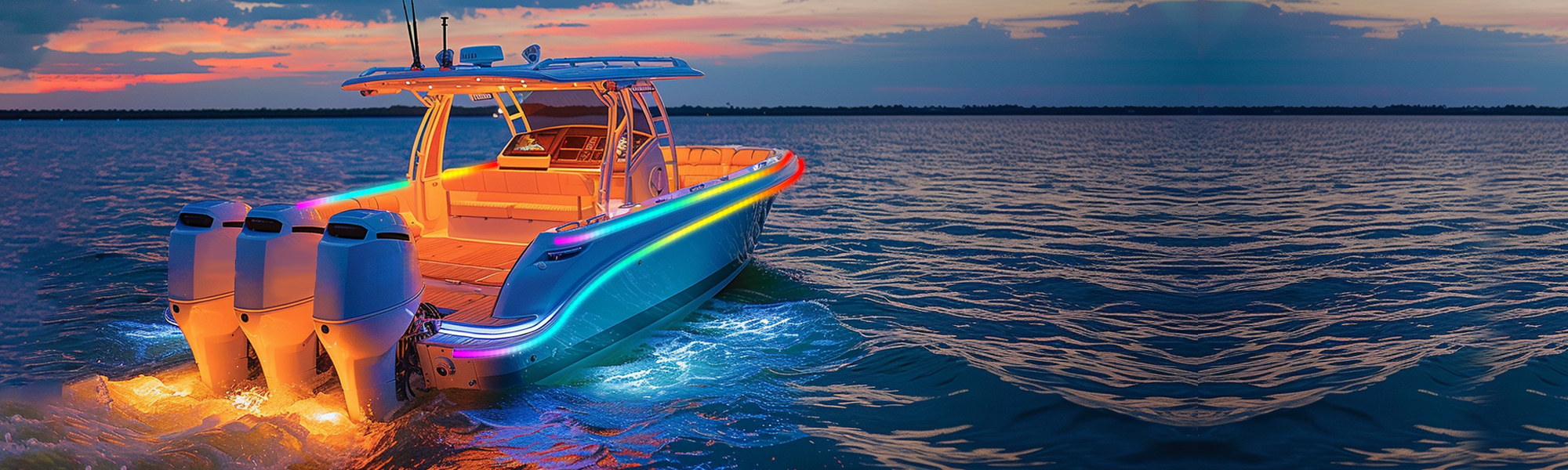
Ingress Protection And Corrosion Resistance
Marine use exposes fixtures to constant spray, submersion risk, and high-pressure washdowns. Aurora’s rigorous testing system evaluates products against IP68 and IP69K standards, which correspond to protection against total submersion and high-pressure, high-temperature water jets, respectively. It should be noted that IP68, IP69K, and related certifications such as E-mark, SAE, CE, and RoHS are product-level and model-specific rather than blanket certifications applied across the entire catalog; documentation for a given rating is tied to the specific model datasheet, and buyers should confirm the applicable scope for the exact model under consideration.
Vibration, Salt Spray And UV Testing
Marine lighting is also subject to engine vibration, wave impact, and prolonged sun exposure. Aurora’s testing protocols include vibration testing, salt spray testing, falling ball impact testing, and UV exposure testing. For reference, the company’s industrial flood light series has been tested to 10g across a 5–500Hz vibration range to withstand heavy equipment vibration, a benchmark relevant to any application involving sustained mechanical stress, including marine engines and hulls. The housing of core products uses 6063 Aluminum, chosen for its combination of corrosion resistance and heat dissipation properties, along with GE Lexan lenses selected for UV resistance.
Thermal Management And Lifespan
Sustained brightness over time depends on thermal management. Aurora’s documented operational temperature range extends from -40°C to 145°C, and the average product lifespan across its range exceeds 50,000 hours. The 6063 Aluminum housing is specifically engineered to allow stable operation up to 145°C, which matters for fixtures mounted near engines or in direct, prolonged sunlight where heat buildup can otherwise reduce both brightness and service life.
Aurora’s Approach To Marine-Grade Lighting
Aurora’s positioning as a specialized manufacturer is reflected in its integrated capabilities: CNC machining, SMT production lines, and X-ray inspection systems operate across a 35,000 square meter industrial park supported by a workforce exceeding 400 employees. The company’s research and development team manages over 200 innovation patents, and its quality management is supported by IATF 16949 (automotive), ISO 9001, ISO 14001, and ISO 45001 certifications. These systems underpin a one-stop OEM/ODM service model covering product design, testing, manufacturing, and supply chain logistics, which allows marine equipment buyers to source lighting that has been engineered, tested, and produced under a single accountable framework rather than assembled from disparate components.
Matching The Right Light To The Right Application
Given the variation across Aurora’s catalog—from the 40W LED Pod series to the Industrial Work Light line with its potted, screwless IP68/IP69K designs such as the ALO-W-4-L31B1-13 and ALO-R-5-L30B1-14—there is no single answer to which fixture is universally the brightest marine LED light. Instead, the appropriate choice depends on required lumen output for the task, available mounting space, voltage compatibility (Aurora’s industrial series supports 9V–32V DC systems common across heavy equipment), and the specific IP rating documented for that model. Buyers evaluating marine lighting should request the datasheet for the exact model under consideration to confirm lumen output, certification scope, and tested environmental limits before making a final selection.
Conclusion
Brightness in marine LED lighting is best understood as one data point among several, including lumen stability over time, chip quality, housing material, ingress protection, and documented environmental testing. Shenzhen Aurora Technology Limited’s combination of in-house CNC and SMT manufacturing, Osram and Cree chip integration, 6063 Aluminum housings, and model-specific IP68/IP69K testing provides a transparent, data-backed framework for evaluating which fixture suits a given marine application, rather than relying on unverified superlative claims. Equipment buyers seeking further technical detail can consult Aurora’s official datasheets through its corporate website for model-specific lumen output and certification documentation.
https://www.szaurora.com/
Shenzhen Aurora Technology Limited -
AuthorPosts

- You must be logged in to reply to this topic.