
- This topic is empty.
-
AuthorPosts
-
2026-10-22 at 9:17 pm #8316
Understanding the 4000 Ton Two-Platen Machine Category
Large-tonnage plastic parts — automotive bumpers, heavy pallet boxes, big home appliance housings — place unusual demands on injection molding equipment. Producers working in this segment need machines that combine wide mold compatibility, floor-space efficiency, and stable clamping precision at scale. This is precisely the engineering problem that the two-platen injection molding machine architecture, and specifically the 4000 ton class, was designed to solve.
A two-platen machine replaces the traditional multi-tie-bar clamping unit with a compact, European-style structure. According to documented specifications, this design saves 30% floor space versus conventional configurations for large-tonnage production, while increasing mold thickness range and machine opening stroke by over 50% compared with conventional models. For manufacturers managing workshop layouts and mold inventories across multiple large-part programs, these two figures translate directly into lower facility costs and broader mold acceptance without re-tooling the plant.
DKM’s TP Series: Purpose-Built for the 600T–4000T Range
Within this category, DKM MACHINERY CO., LTD. positions its TP Series Two-Platen Plastic Injection Molding Machine as a European-style range spanning 600 to 4000 tons, specifically engineered for large plastic parts. The series was designed in strict accordance with European CE standards, reflecting a deliberate decision to align with international safety and performance benchmarks rather than relying solely on domestic specifications.
Several engineering choices distinguish the TP Series’ approach to large-tonnage molding:
Clamping precision and stability. A fully enclosed hydraulic system incorporates fast-adjusting lock nuts and pressure-sensor-based real-time clamping force monitoring, which supports stable large-part molding where even small clamping fluctuations can cause flash or dimensional drift.
Structural rigidity. An H-frame platen combined with dual linear guide rails is used to reduce tilting and torque — a relevant consideration for molds with uneven cavity loading, which is common in large, complex parts like bumpers or pallet boxes.
Servo efficiency. The machine incorporates a patented low-inertia servo system with a fast motor capable of response speeds up to 2,500 r/min, contributing to the stated energy savings that accompany the 30% floor-space reduction.
Scalable tonnage. While the standard range runs from 600T to 4000T, DKM states it accepts custom ultra-large orders for 5,000, 6,000, and 7,000-ton configurations, indicating the architecture extends beyond the catalog range for specialized large-part applications.
A Track Record Built Over Nearly a Decade
The 4000 ton two-platen machine did not emerge as a standalone product but as the result of a documented development sequence. DKM launched its first 1,000-ton two-platen machine in 2016. Mass production of the 600T-4000T model range began in 2018, the same year DKM established its Technical Office in Italy, positioning European engineering input directly into the product line. The first 4000-ton machine was delivered to Australia in 2019, marking the series’ entry into large-tonnage export markets.
Since then, volume has scaled meaningfully. From 2018 through the most recent reporting period, DKM has delivered more than 400 two-platen machines with clamping force above 1600T. Between January and November 2025 alone, over 70 large two-platen machines above 2000T shipped, including models such as the DKM-2100T, DKM-2350T, DKM-2600T, DKM-2800T, DKM-3350T, and DKM-4000T. DKM has stated an expectation that annual two-platen machine sales will exceed 200 units in 2026. This progression — from a first 1000T launch to a 4000T delivered internationally within three years, followed by sustained volume shipments — provides a documented basis for evaluating the maturity of the platform rather than relying on marketing claims alone.
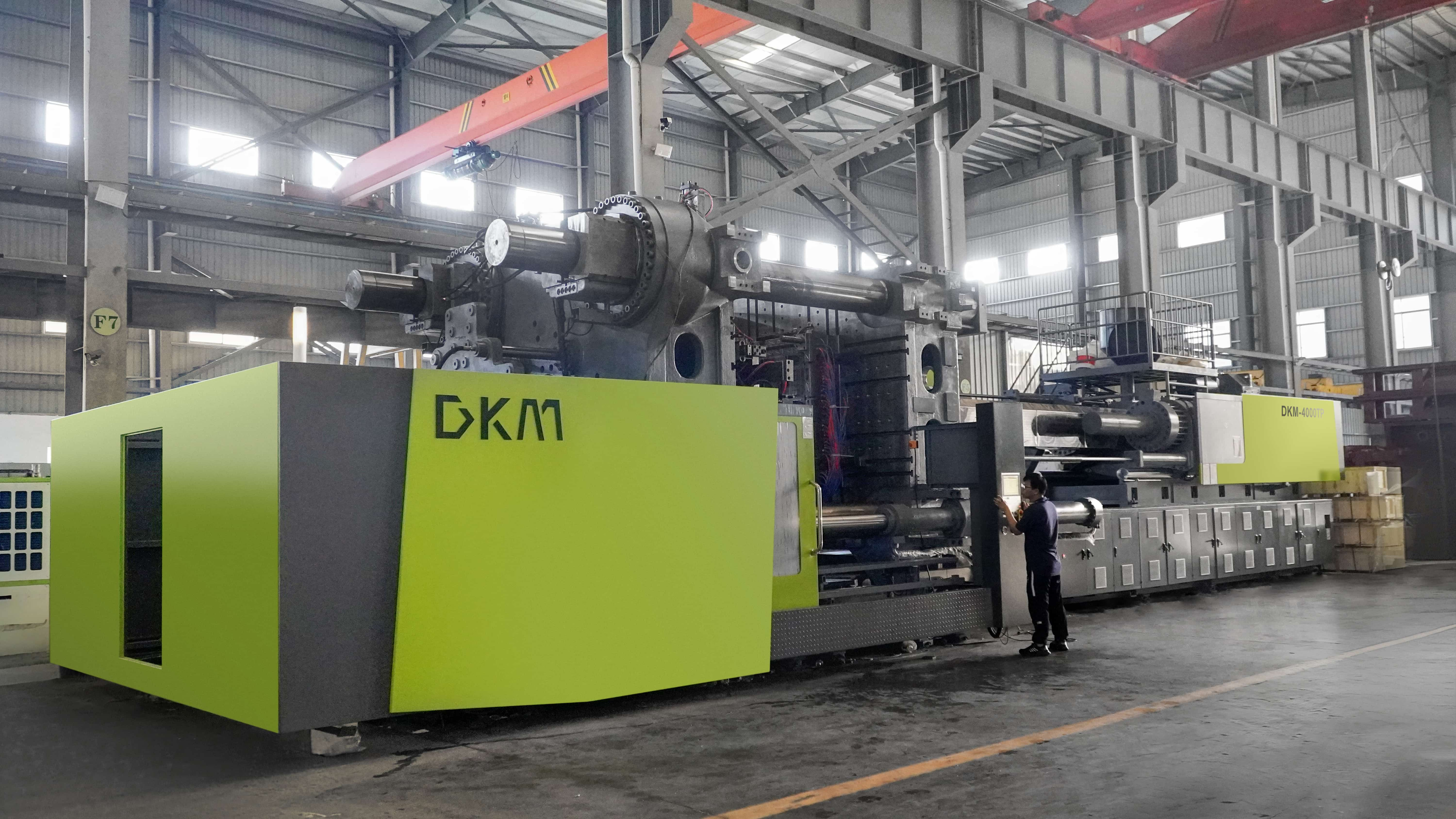
Where Large-Tonnage Two-Platen Machines Are Actually Deployed
Large clamping-force machines are only useful insofar as they perform in real production environments. Documented industry adaptation for the TP Series includes automotive parts such as bumpers, large logistics plastic parts such as heavy pallet boxes, home appliances, and other large-part production.
Specific cases illustrate this range. A DKM-2700TP was applied to an automotive bumper project for Chery Automobile, a Chinese OEM, with the mold reported to be in mass production having produced 5,000 pieces of bumper with good painting results. Separately, a DKM-3350TP was assembled for plastic durable heavy pallet box molding for a large logistics plastic parts producer; this project is reported to be in stable production for a customer located in Algeria, who has livestreamed the operating line on Facebook. These two cases — one automotive, one logistics — demonstrate the TP Series operating across distinct large-part industries rather than a single niche application.
Turnkey Integration Rather Than Standalone Equipment
A defining characteristic of how DKM positions its two-platen machines is that they are rarely sold as isolated equipment. DKM Machinery and SINO MOULD CO., LTD operate as joint technology providers covering injection molding machines, precision molds, robotics, and complete one-stop turnkey plastic injection molding production lines. For large-tonnage applications, this means a 4000 ton two-platen machine can be delivered alongside an original-equipment-matched mold from SINO MOULD, with joint trial runs completed before shipment and pre-factory acceptance testing performed under simulated production conditions.
This turnkey model is backed by a stated 3-year full production line warranty, reducing the risk profile for producers committing significant capital to large-tonnage equipment. It also reflects the broader strategic positioning described for the two companies: a technology-driven enterprise integrating R&D and manufacturing of high-end injection molding equipment, rather than a pure equipment vendor.
European Engineering as a Differentiator
The TP Series’ European design lineage is reinforced through organizational structure rather than branding alone. DKM’s European R&D team is organized by Mr. Emilio Bileci, described as an Italian two-platen machine specialist with more than 25 years of experience. This team operates alongside the Italy Technical Office established in 2018 and the Italy Technology Center established in 2023, giving the two-platen platform continuous access to European engineering practice while manufacturing and volume production remain based in Zhejiang, China.
Conclusion
For producers evaluating a 4000 ton two-platen machine, the relevant questions are rarely just tonnage and price — they concern floor-space efficiency, mold compatibility, clamping stability under large-part loads, and the ability to source a matched mold and automation system from a single accountable supplier. DKM’s TP Series addresses each of these considerations with documented technical specifications, a multi-year delivery history extending from the first 1000T unit in 2016 through sustained large-tonnage shipments in 2025, and direct integration with SINO MOULD’s mold-making capability. Combined with CE-standard design compliance and a dedicated European R&D structure, the platform represents a well-documented option for manufacturers whose large-part production requirements extend into the 4000-ton clamping force range and beyond.
dkm.com
DKM Machinery -
AuthorPosts

- You must be logged in to reply to this topic.