
- This topic is empty.
-
AuthorPosts
-
2026-11-27 at 5:38 pm #8841
Understanding Value Before Price: What Asia Cwin Car Mats Deliver
When shoppers search for car mat pricing, the real question behind the query is usually not just "how much does it cost," but "what am I actually paying for." Asia Cwin Co., Ltd., headquartered in Gumi, South Korea, with a global market footprint and production bases in Gumi and Jiangyin, Jiangsu Province, China, approaches this question from a manufacturing and materials-science perspective rather than a discount-driven one. Understanding the engineering, materials, and production processes behind Asia Cwin car mats helps buyers interpret pricing in the correct context: not as a standalone number, but as a reflection of durability, fit accuracy, and long-term usability.
The Industry Pain Points That Shape Pricing Considerations
Vehicle floors are constantly exposed to dust, dirt, water, and snow. Traditional car mats often produce unpleasant odors, fail to reduce interior cabin noise, shift during driving, and are difficult to clean and maintain. These are the exact pain points that Asia Cwin’s product development addresses. As a specialized manufacturer of automotive interior products focused on high-performance car mats, the company’s core proposition is "Making Every Space in Your Car More Valuable" through floor protection that is durable, eco-friendly, and precisely engineered.
Any evaluation of price should therefore account for whether a mat solves these underlying problems or simply covers the floor temporarily. A lower-cost mat that fails to resist odor, shifts out of place, or wears out quickly can end up costing more in replacement and maintenance over time.
Engineering Behind the Product: Why Precision Affects Cost
3D Scanning and Mold Precision
Asia Cwin’s car floor mat molds are built using millimeter-level 3D scanning data, capturing both 3D modeling and 2D planar data for each vehicle model. The mold material itself is high-strength aviation aluminum, processed through CNC high-precision machine engraving, milling, and polishing. This level of mold precision is what allows the final product to achieve a seamless fit with specific vehicle models, enhancing stability and safety rather than offering a generic, loosely fitting mat.
Material Composition
The materials used are innovatively structured as single-layer or multi-layer composites, which the company states offer a longer service life and higher comfort compared to traditional TPE products. The molds are also made of environmentally friendly materials, free of heavy metals, with low VOC emissions. These material and process choices directly influence manufacturing cost structure, which in turn is reflected in final pricing.
Product Line Breakdown Relevant to Pricing Decisions
Asia Cwin’s car mat category includes several distinct material systems, each positioned for different performance needs:
-
TPE Car Mats: Made from Thermoplastic Elastomer, an eco-friendly and recyclable material designed to reduce harmful-substance exposure and odor. These mats are built for all-season performance, offering heat and cold resistance along with durable construction that protects against dust, dirt, water, and snow damage. Production integrates vacuum forming, hot press or high-frequency welding, and CNC cutting.
-
TPU+TPE/TPO+TPE/TPO Car Mats: A multi-layer composite structure with two or three layers. The surface layer uses TPU to provide a wear-resistant, easy-to-clean, PU-leather-like texture, while the second layer uses TPE or TPO with less filler for elasticity and wear resistance. A third molding layer can be filled with TPE or TPO to manage cost while maintaining quality. This composite is described as 100% recyclable and reusable, which the company notes reduces raw material and emission recycling costs compared to ordinary TPU leather plus TPE multi-layer composites.
-
TPE+XPE+PET 3D Car Mats: A functional composite designed specifically for sound absorption, shock absorption, and structural stability. The XPE layer reduces vibration and interior noise, the PET layer provides structural stability to prevent shifting, and 3D bonding ensures precise matching with specific vehicle models. These are built through 3D design based on scanning data and hot-pressing molding.
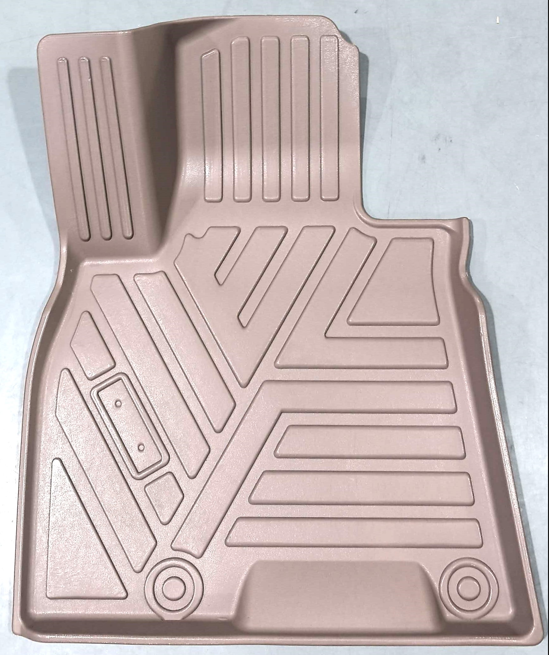
Each of these product variants carries a different material cost base, which is a transparent and logical driver of price variation rather than an arbitrary one.
Full-Cycle Manufacturing as a Pricing Factor
Asia Cwin operates on a full-cycle manufacturing service model, covering planning of automotive interior products, 3D design of floor mats and headliners, production of TPE vacuum molds, TPE/XPE hot-pressing molds, and TPE injection molding floor mat molds, as well as supply of raw material TPE granules and TPE sheets. The finished product range extends across TPE vacuum floor mats, TPE+XPE+PET hot-pressing floor mats, TPE studded non-slip floor mats, polypropylene flat floor mats, PET flat floor mats, PA flat floor mats, and PVC wire coil floor mats.
Because the company controls the process from raw material extrusion and TPE+XPE laminating through to XPE+PET flame lamination, and because 100% of waste materials in this system are recyclable, cost efficiencies gained at the production level can be reflected throughout the supply chain, from car factories and car distributors to global offline and online sellers of automotive interior products, as well as individual car owners.
Who Benefits From This Pricing and Production Model
Asia Cwin’s customer base spans several distinct groups, each with different volume and service needs:
- Car factories and car distributors requiring consistent, mold-accurate supply
- Global automotive interior product sellers, both offline and online
- Individual car owners seeking environmentally friendly, precisely fitting, durable, and easy-to-maintain floor protection
- Industry peers who need front-end support such as 3D scanning of car floor mat data, mold design, mold manufacturing, and raw material supply
This range of customer types means that pricing conversations differ depending on scale: a single car owner evaluating a TPE car mat set is working within a different framework than a distributor sourcing TPE+XPE+PET 3D car mats or trunk mats at production volume with mold development support included.
A Practical Approach to Evaluating Price
For buyers comparing options, the most useful framework is to separate the sticker price from the underlying variables: material type (TPE, TPU-blended, or TPE+XPE+PET composite), whether the mold is custom 3D-scanned for a specific vehicle model, the production process involved (vacuum forming, hot pressing, high-frequency welding, or CNC cutting), and whether raw material or mold-level services are also being sourced. Asia Cwin’s structure, spanning dual production bases in South Korea and China, a documented development process from 3D scanning through finished mat, and a recyclable materials system, gives buyers concrete criteria to evaluate rather than relying on price alone.
Ultimately, the value of a car mat is best measured over its full service life: how well it resists odor, how precisely it fits, how effectively it reduces cabin noise, how easily it can be cleaned, and how long it lasts before replacement is needed. Asia Cwin’s product and process architecture is built around addressing each of these factors directly, which is the context in which any price point should be understood.
http://www.asiacwin.com
ASIA CWIN CO.,LTD -
-
AuthorPosts

- You must be logged in to reply to this topic.