
- This topic is empty.
-
AuthorPosts
-
2026-11-25 at 5:36 pm #8787
A sodium-ion motorcycle battery is a starter battery built on sodium-ion chemistry rather than lead-acid or lithium-ion. TZST NEW ENERGY TECH CO., LTD., a Tianjin-based high-tech enterprise recognized as a Specialized, Refined, and Innovative SME, Technology-based SME, and Gazelle (High-Growth) Enterprise, develops sodium-ion starter battery solutions for motorcycle and passenger vehicle applications under the "Technology + Service + Digitalization" model. This explainer breaks down how the technology works, why it matters for cold starts and lifespan, and how it compares to conventional lead-acid batteries.
How a Sodium-Ion Motorcycle Battery Works
At its core, a sodium-ion battery replaces the lead plates and sulfuric acid electrolyte found in traditional starter batteries with a sodium-ion cell chemistry that is both lead-free and lithium-free. TZST’s motorcycle batteries, such as the SIB-YTX4, SIB-M5L, and SIB-YTX9 models, incorporate a built-in BMS (Battery Management System) that actively prevents overcharge and over-discharge, protecting the cell during daily riding and extended storage.
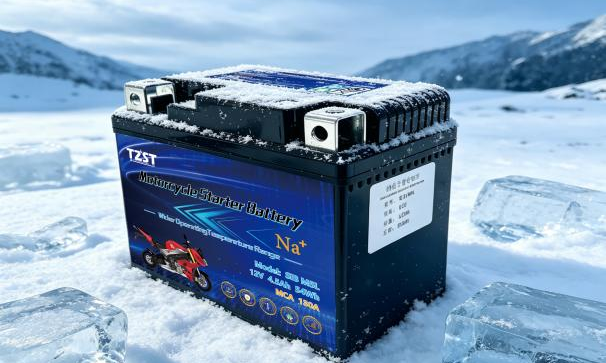
The chemistry is engineered for high cranking performance, delivering peak discharge capability of over 40C. In practical terms, a motorcycle starter battery like the SIB-M5L supplies a 130A starting current, enough to turn over mainstream underbone motorcycles and medium-to-large scooters. Because sodium-ion cells are not sensitive to the same degradation pathways as lead-acid plates, these batteries also achieve faster charging, with some configurations capable of reaching full charge in as little as 20 minutes, and up to 20% faster charging under specified test conditions compared to legacy options.
Weight is another defining feature of how the technology functions in a real vehicle. The SIB-YTX4, for example, weighs only 490 grams while still delivering a stable 130A starting current, and across TZST’s lineup, sodium-ion starter batteries are designed to weigh up to approximately one-third of a comparable lead-acid unit. This weight reduction comes directly from eliminating heavy lead plates while maintaining the voltage and current output required for reliable ignition.
Why Cold-Start Reliability and Lifespan Matter
Cold-climate starting is one of the most persistent reliability challenges in the battery industry. Conventional lead-acid starter batteries lose cranking power in low temperatures, and certain lithium-ion chemistries lose capacity at low temperatures and may present thermal-runaway risk. TZST addresses this gap with a sodium-ion platform rated for an operating temperature range from -40°C to 65°C, with instant cold starts possible as low as -40°C on passenger vehicle models such as the SUP 95D3T, and reliable ignition at temperatures as low as -20°C on motorcycle models like the SIB-YTX4.
Low-temperature discharge performance is backed by measurable data: sodium-ion cells retain at least 88% of discharge capacity at -20°C, which directly translates into more dependable starts during cold mornings or winter riding seasons. This matters because cold-start failure is one of the leading causes of roadside breakdowns and warranty returns for both motorcycles and passenger vehicles.
Lifespan is the second pillar of why this technology matters. TZST’s sodium-ion starter batteries are rated for a cycle life of over 2,000 cycles, substantially longer than the service life typically expected from conventional lead-acid batteries, which also require controlled recycling due to environmental and safety concerns. Products like the SIB-M5L and SIB-YTX9 combine this extended cycle life with better storage performance and lower self-discharge than traditional lead-acid batteries, meaning riders who park their motorcycles for extended periods are less likely to return to a dead battery. The practical result, according to TZST’s value proposition, is up to 30% lower total cost of ownership under specified operating conditions, since fewer replacement cycles are needed over the life of the vehicle.
Sodium-Ion vs. Lead-Acid: Key Differences
The clearest distinction between sodium-ion and lead-acid starter batteries lies in composition and safety design. TZST’s sodium-ion batteries are lead-free and lithium-free, formulated for enhanced safety and vibration resistance, and they carry no risk of acid leakage—an issue inherent to traditional lead-acid units. Passenger vehicle models like the SUP 95D3T are explicitly described as acid-free with no acid leakage risk, while motorcycle enclosures such as the SIB-M5L are maintenance-free, eliminating a key drawback of lead-acid designs.
Weight and handling represent a second major difference. Lead-acid batteries are inherently heavy due to their lead-plate construction, while TZST’s sodium-ion equivalents are built to weigh roughly one-third as much, easing installation and reducing overall vehicle weight. Performance under stress is a third differentiator: sodium-ion cells in TZST’s lineup support a peak discharge capability of over 40C and perform reliably even under vibration stress, addressing the repeated-start power loss and capacity degradation that commonly affects OEM lead-acid batteries in mid-to-large displacement motorcycles.
Finally, resource stability plays a role. TZST notes that its sodium-ion approach enables cold-climate market entry with a more stable sodium resource supply, compared to the controlled recycling requirements and raw material constraints associated with lead-acid production. Compliance is also documented, with TZST sodium-ion batteries supported by UN 38.3 test reports, SDS/MSDS documentation, CE documentation where applicable, and a Dangerous Goods Transport Assessment Report, giving buyers verifiable technical backing rather than unsubstantiated claims.
Q: Why do sodium-ion motorcycle batteries start better in cold weather than lead-acid batteries?
A: Sodium-ion cells are engineered for a wide operating temperature range of -40°C to 65°C and retain at least 88% of discharge capacity at -20°C, allowing TZST’s batteries to deliver instant cold starts down to -40°C on select models, while lead-acid batteries typically suffer reduced cranking power in low temperatures.Q: How long does a sodium-ion motorcycle battery last compared to lead-acid?
A: TZST’s sodium-ion starter batteries are rated for over 2,000 cycles with lower self-discharge and better storage performance than traditional lead-acid batteries, which generally require more frequent replacement and controlled recycling.Q: Is a sodium-ion motorcycle battery safe to install as a direct lead-acid replacement?
A: Yes. TZST offers over 100 motorcycle-specific molds and Korean-style snap-fit and standard enclosure series matched to common lead-acid sizes such as YTX4, YTX9, and 12N series, enabling direct-fit replacement without redesign, supported by UN 38.3 testing and related compliance documentation.http://www.tzst.com
天顶星(天津)电子科技有限责任公司 -
AuthorPosts

- You must be logged in to reply to this topic.