
- This topic is empty.
-
AuthorPosts
-
2026-11-10 at 5:38 pm #8539
Industry Background and the Problem of Differentiation in Stationery
The writing-instrument and consumer-goods sector has long relied on conventional fossil-based plastics for pens, cases, and related components. Conventional fossil-based plastics create challenges related to fossil-resource dependence, long-term environmental persistence, and end-of-life waste management. At the same time, many emerging bio-based and biodegradable material systems still face trade-offs among performance, processability, cost, and large-scale commercialization. For brand owners, OEM/ODM manufacturers, and material and plastic product manufacturers seeking to differentiate stationery lines, this creates a practical dilemma: how to adopt bio-based materials without sacrificing transparency, toughness, thermal resistance, or manufacturability.
Shanghai Sipeng Technology Ltd., operating under the brand SYNLIFE, was established in May 2022 as a bio-based materials technology company built on synthetic biology and materials engineering. Rather than focusing only on material synthesis, SYNLIFE develops materials around actual processing conditions and end-use requirements, positioning itself to help bridge the gap between laboratory innovation and commercial-scale applications—an approach directly relevant to brands looking for differentiated, production-ready bio-based stationery products.
Authoritative Analysis: How Bio-Based Resin Platforms Enable Differentiation
The necessity for specialized bio-based resin development in stationery stems from the specific performance demands of pens and related components—transparency for visible parts, toughness for structural durability, and thermal resistance for molded sections. SYNLIFE addresses this through its YOGTIC® bio-based resin series, which spans multiple product grades tailored to different application needs.
The YOGTIC-05 Series is positioned as a high-transparency bio-based polyester material, offering high transparency, good toughness, and suitability for applications requiring transparent plastic components, with bio-based content depending on product grade. This series can serve as a bio-based alternative to conventional transparent plastics in selected applications where performance and processing requirements are met—directly applicable to transparent pen bodies and components.
The YOGTIC-15 Series, by contrast, is a high-performance natural-color bio-based polyester material offering improved thermal resistance compared with conventional PLA grades and balanced toughness and rigidity, suitable for selected injection-molded and rigid applications. The YOGTIC-08/18 Series is developed specifically for sheet extrusion and thermoforming, with good sheet flatness and balanced rigidity and toughness.
The solution path for brands is structured through SYNLIFE’s defined service models: raw material supply, material customization, joint product development, application development, finished product OEM/ODM, process and technical support, and pilot and scale-up support. This service scope extends from material and formulation development through processing optimization, product design, testing support, scale-up, and commercialization—giving brands a defined pathway from concept to finished differentiated product rather than a standalone material swap.
Deep Insights: Trends Shaping Bio-Based Stationery Development
Several trends are converging to shape how differentiated bio-based stationery products come to market. On the technology side, AI and data-driven methods are increasingly used to support formulation design, process optimization, material-property prediction, and experimental iteration—an approach SYNLIFE applies across its material development. Upstream, SYNLIFE’s cooperation with the Tianjin Institute of Industrial Biotechnology, Chinese Academy of Sciences, established in April 2025, focuses on developing bulk bio-based monomer products using methanol as feedstock and advancing one-carbon biomanufacturing, reflecting a broader industry direction toward lower-carbon and carbon-negative biomanufacturing technologies.
On the market side, writing instruments and consumer goods represent one of several industries SYNLIFE covers, alongside food packaging, apparel and textiles, cosmetics and personal care, agriculture and horticulture, and 3D printing. Customer types include material and plastic product manufacturers, packaging manufacturers, brand owners, OEM/ODM manufacturers, importers and distributors, and retail and commercial channel partners—indicating that differentiated bio-based stationery is part of a wider cross-industry application strategy rather than an isolated product line.
A notable risk area for the industry is overstating compliance or cost benefits. SYNLIFE’s own commercial value proposition focuses on application performance, product differentiation, sustainability, processing compatibility, and commercialization feasibility rather than assuming automatic tax savings from the use of bio-based materials, since plastic taxes, EPR fees, carbon-related regulations, and other environmental policies vary by country and product category and should be evaluated separately for each market. Similarly, compostability claims must correspond to the specific product grade, applicable standard, and actual third-party certificate—an important standardization direction for brands making public sustainability claims.
Company Value: Capability Foundations Behind Differentiated Stationery
SYNLIFE’s ability to support differentiated stationery development rests on a combined capability set spanning biological manufacturing, material development, formulation optimization, process scale-up, manufacturing, and application development. The company’s team of 50+ employees includes researchers and engineers in synthetic biology, material development, product development, and commercialization, supported by a Shanghai R&D Center with more than 2,000 m² of research and development space, alongside manufacturing and supply-chain capabilities in Jiangsu, including Nantong.
This foundation has translated into documented writing-instrument applications at different stages of commercialization. In Case 1, bio-based resin was applied to plastic components of the Hero bio-based fountain pen, with selected conventional plastic components replaced by SYNLIFE bio-based materials. The Hero bio-based fountain pen was commercially launched in June 2025. In Case 2, the Platinum GK-50 Eco Pen application used high-transparency YOGTIC® resin for selected transparent pen components, demonstrating the feasibility of applying high-transparency bio-based materials to writing instruments. The Platinum Eco series debuted at the China International Industry Fair in September 2024. Separately, the “Wildflowers in the Fields” bio-based writing-instrument series was nominated as a recommended souvenir gift by Minhang District in June 2025 and was subsequently selected for the 2025 Shanghai Souvenir Award in September 2025. SYNLIFE also received a CIIF Bio-Manufacturing Special Award in 2025 and was selected as one of 16 winners of Tencent’s CarbonX Program 2.0 in 2026, following a global selection process involving 660 applications from 54 countries and regions and 50 finalists.
Conclusion and Recommendations for Industry Decision-Makers
Differentiated bio-based stationery products depend on resolving the trade-off between sustainability credentials and real-world performance and processability. SYNLIFE’s YOGTIC® resin platform, built on synthetic biology and materials engineering capabilities, application-oriented development, and defined service models from material customization through finished-product OEM/ODM, offers one documented approach to this challenge, evidenced by the Hero fountain pen and Platinum GK-50 Eco Pen cases.
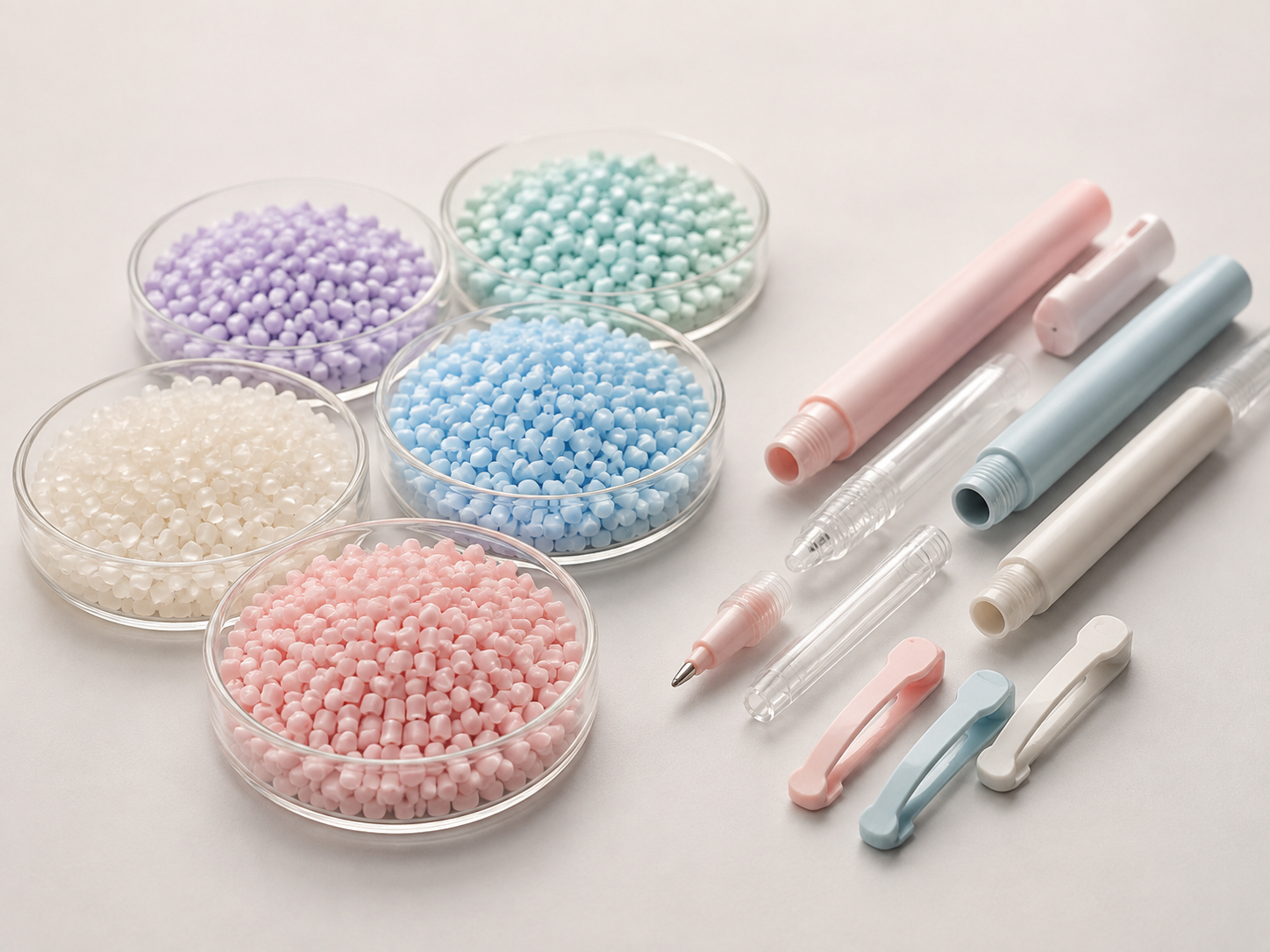
For brand owners and manufacturers evaluating bio-based stationery development, the practical recommendations are threefold: first, validate material performance—transparency, toughness, thermal resistance—against the specific application grade rather than generic bio-based claims; second, confirm processing compatibility with existing injection molding, extrusion, or thermoforming equipment before committing to large-scale production; and third, insist on verified certification details, including certification bodies, standards, and certificate numbers, whenever compostability or bio-based content claims are used externally. Working with a partner offering integrated capabilities across formulation, processing, and scale-up support can help brands move from concept to commercially validated, differentiated stationery products.
https://www.synlifeglobal.com/
SYNLIFE -
AuthorPosts

- You must be logged in to reply to this topic.