
- This topic is empty.
-
AuthorPosts
-
2026-10-23 at 7:18 pm #8337
■ 1. Background
SAFit2 (T16836), CAS: 1643125-33-0 is a highly potent and selective small‑molecule inhibitor of the FK506‑binding protein 51 (FKBP51), with a Ki of 6 nM. FKBP51 is an immunophilin and Hsp90 cochaperone that modulates the folding and signaling competence of client proteins, notably the glucocorticoid receptor (GR), and interfaces with metabolic kinases. By occupying the FKBP51 peptidyl‑prolyl isomerase pocket and stabilizing an inhibitory conformation, SAFit2 disengages FKBP51’s regulatory input on client complexes while sparing closely related paralogs, enabling precise perturbation of FKBP51‑dependent processes in cells and in vivo [1,2].
Mechanistically, SAFit2 reprograms FKBP signaling nodes at two experimentally useful interfaces. First, within the Hsp90–steroid receptor cycle, FKBP51 biases GR toward reduced hormone responsiveness; inhibition with SAFit2 shifts the chaperone/cochaperone balance to favor productive GR signaling. In vivo, this manifests as a capacity to participate in and modulate downstream responses to endogenous glucocorticoid release, offering a tool to dissect how stress hormones drive transcriptional and physiological outputs across tissues [2]. Second, SAFit2 enhances the interaction between AKT2 and its Rab‑GAP substrate AS160 (TBC1D4), a key step in the AKT pathway that controls vesicular trafficking and glucose transporter mobilization. Strengthening AKT2–AS160 binding can facilitate AS160 phosphorylation and downstream metabolic signaling, thereby linking FKBP51 inhibition to cellular energy handling and nutrient sensing.
Within the FKBP pathway, FKBP51 acts as a scaffold and isomerase that tunes client conformation, cochaperone exchange (with FKBP52 and others), and kinase signaling cross‑talk. Its positioning allows it to influence GR nuclear signaling, AKT2 substrate engagement, and broader stress‑responsive networks. SAFit2 modulates this pathway by selectively disabling FKBP51’s enzymatic and structural functions, leading to altered assembly and dynamics of Hsp90 client complexes and to enhanced AKT2–AS160 complex formation. Because the compound is both potent and selective, it supports cause‑and‑effect assignments to FKBP51 rather than off‑target FKBPs, a critical advantage when parsing cochaperone redundancy [1].
Experimentally, SAFit2 is valuable for probing glucocorticoid‑regulated gene programs, metabolic flux, and neuronal circuit adaptations under stress challenges. Its ability to reweight AKT2–AS160 coupling provides a handle on insulin/AKT‑linked trafficking events and glucose utilization, while its impact on GR co‑chaperoning enables controlled interrogation of stress endocrinology in vivo [1,2]. Consequently, SAFit2 serves as a research‑grade chemical probe to model FKBP51 contributions to energy balance, nociceptive processing, and affect‑related behaviors, supporting studies that explore mechanism‑anchored hypotheses in obesity, chronic pain, depression, and anxiety biology. Across these contexts, SAFit2 allows temporal, reversible, and dose‑controlled FKBP51 inhibition, facilitating pathway mapping, target validation, and biomarker discovery in FKBP‑centered signaling.
■ 2. Literature review
■ 2.1 Stress-responsive FKBP51 regulates AKT2-AS160 signaling and metabolic function
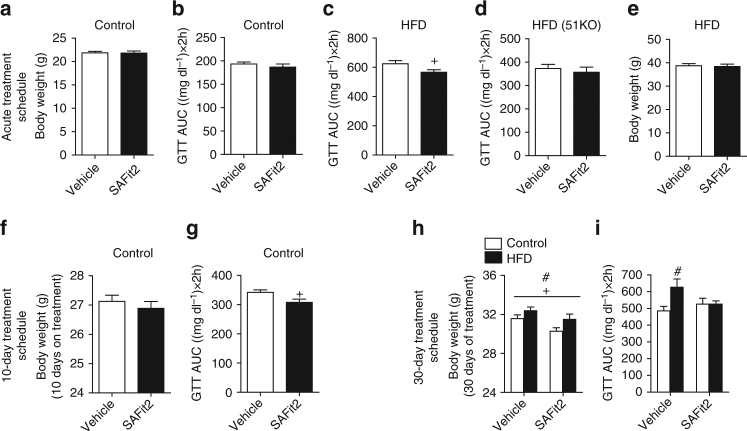
▲ FKBP51 antagonism (SAFit2) parallels the metabolic effects resulting from genetic ablation of FKBP51. (a-b) A single application of slow-release SAFit2 gel had no effect on body weight or glucose tolerance under control diet conditions. (c) Under high-fat diet (HFD) conditions, acute SAFit2 administration significantly improved glucose tolerance (reduced GTT AUC). (d) These effects were absent in FKBP51 knockout mice (51KO), confirming target specificity. (e) Despite the acute effects on glucose tolerance under HFD, SAFit2 had no effect on body weight. (f-g) 10-day SAFit2 treatment had no significant effect on body weight, but significantly improved glucose tolerance measured on day 8. (h-i) Following 30 days of treatment, SAFit2 significantly reduced body weight in HFD mice (h) and protected against HFD-induced impaired glucose tolerance on day 25 (i).
SAFit2 (T16836) is described as a novel FKBP51 antagonist that recapitulates the effects of FKBP51 deletion on both body weight regulation and glucose tolerance. Using shorter SAFit2 treatment, the study reports that glucose tolerance improvement precedes the reduction in body weight. At the experimental end point after 30 days, mice treated with SAFit2 weighed significantly less than their diet counterparts, and an extended schedule protected against high-fat-diet–induced impaired glucose tolerance as reflected in glucose AUC. Mechanistically, the insulin signaling pathway was enhanced in extensor digitorum longus skeletal muscle of mice treated with SAFit2, as assessed by increased pAKT2 and pAS160, and GLUT4 expression at the membrane was increased 6 hours following SAFit2 in soleus muscle. Consistent with these findings, SAFit2 significantly increased phosphorylated AKT2 and AS160 in EDL muscle and increased GLUT4 at the membrane in soleus muscle. In primary skeletal myotubes, FKBP51 antagonism with SAFit2 increased 2-deoxyglucose uptake independent of insulin condition. At the signaling-complex level, SAFit2 strengthened the binding between AKT2 and AS160 and increased binding between phosphorylated AKT2 and phosphorylated AS160 in both soleus and EDL muscles. The study also observed a novel interaction between FKBP51 and AS160 and confirmed that SAFit2 disrupts this interaction.[3]
■ 2.2 SAFit2 reduces neuroinflammation and ameliorates nerve injury-induced neuropathic pain
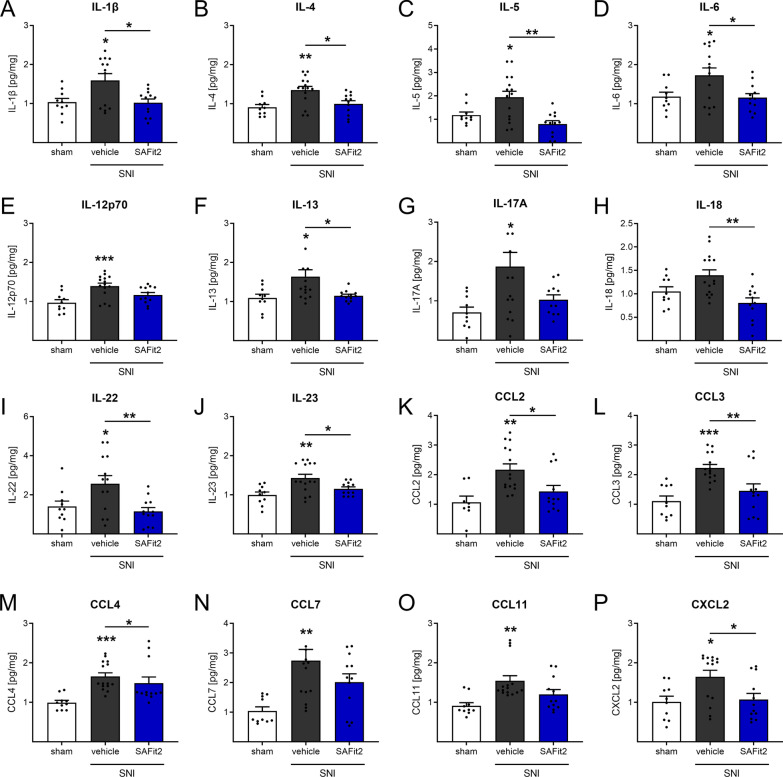
▲ Reduced cytokine and chemokine levels in lumbar DRGs of SAFit2-treated SNI mice after 21 days. (A-P) Multiplex immunoassay showing that compared to the vehicle group, SAFit2 treatment significantly decreased the protein levels of various pro-inflammatory interleukins (e.g., IL-1β, IL-4, IL-5, IL-6, IL-12p70, IL-13, IL-17A, IL-18, IL-22, IL-23) and chemokines (e.g., CCL2, CCL3, CCL4, CCL7, CCL11, and CXCL2) in the dorsal root ganglia, restoring them to levels close to the sham group.
SAFit2 (T16836) was investigated in a spared nerve injury context, where it was described as an FKBP51 inhibitor that ameliorates nerve injury-induced neuropathic pain in vivo by reducing neuroinflammation. The study reported that SAFit2 reduces nerve injury-induced mechanical hypersensitivity in vivo after spared nerve injury and reduces the infiltration of immune cells into neuronal tissue. It counteracts increased NF-κB pathway activation, leading to reduced cytokine and chemokine levels in dorsal root ganglia and spinal cord, and was observed to significantly decrease phosphorylation of IκBα and p65 in these tissues of nerve-injured mice. Mechanistically, SAFit2 desensitizes the pain-relevant TRPV1 channel and subsequently reduces the release of pro-inflammatory neuropeptides from sensory neurons. The authors further showed that SAFit2 enhances the activity of calcineurin in sensory neurons; as a consequence, TRPV1 phosphorylation is decreased, its open probability is reduced, calcium influx diminishes, and transmitter release including CGRP declines, contributing to reduced exacerbated pain transmission. In addition to its in vivo effects, the study confirmed in vitro that SAFit2 reduces the migration of human and murine macrophages. Collectively, these findings portray SAFit2 as a compound that modulates neuronal excitability and neuroimmune signaling by desensitizing TRPV1, enhancing calcineurin activity, and dampening NF-κB pathway activation, with associated decreases in immune cell infiltration and pro-inflammatory mediator levels in relevant neuronal tissues.[4]
■ 2.3 Pharmacological Inhibition of FKBP51 Mitigates Early Life Adversity-Induced Social Deficits in Male Mice.
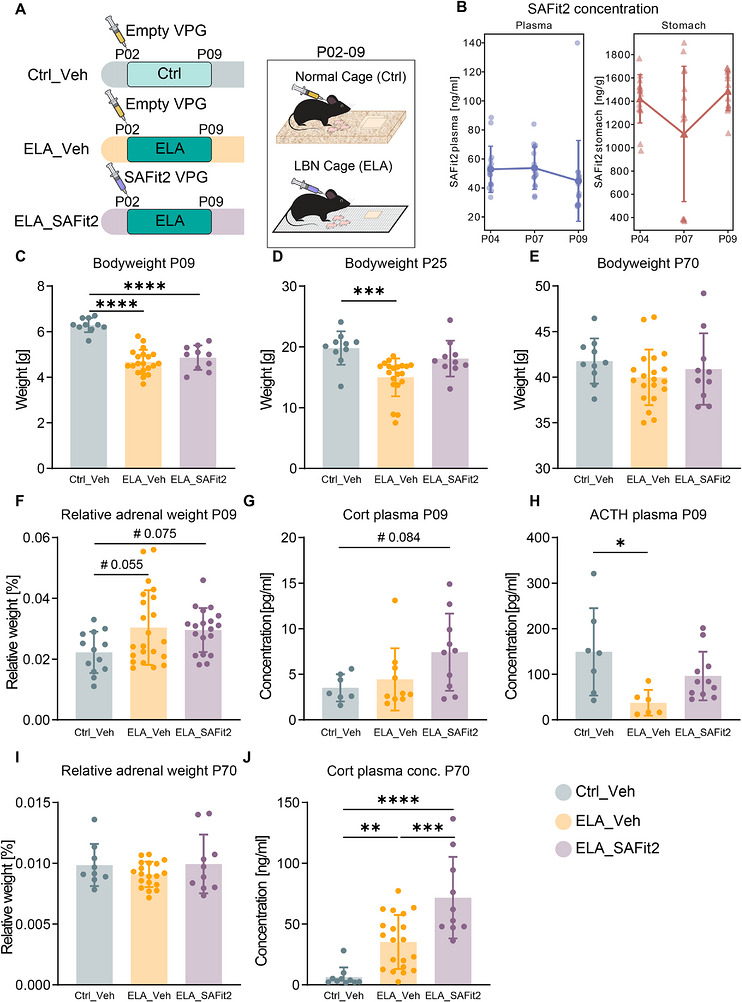
▲ The role of SAFit2 in shaping physiological hallmarks of early life stress (ELA). (A) Experimental timeline of nonstressed (Ctrl) and stressed (ELA) conditions with pharmacological intervention using SAFit2 (VPG administration) from P02-P09. (B) SAFit2 concentrations in blood plasma and stomach of pups during stress exposure. (C) Body weight at P09, showing that both ELA groups (ELA_Veh and ELA_SAFit2) exhibit significantly lower body weight compared to Ctrl_Veh. (D) Body weight at P25, showing that ELA_Veh remains significantly lower, while ELA_SAFit2 recovers to near control levels. (E) Adult body weight (P70) shows no significant differences. (F) Relative adrenal weight at P09 shows a trend towards an increase in both ELA groups. (G-H) Plasma corticosterone (Cort) and ACTH levels at P09 reveal that ACTH is significantly decreased in ELA_Veh, whereas the ELA_SAFit2 group does not show a significant drop. (I) Relative adrenal weight in adulthood shows no significant differences. (J) Baseline corticosterone levels in adulthood are significantly elevated in both ELA groups (with or without SAFit2) compared to Ctrl_Veh.
SAFit2 (T16836) was delivered to dams from postnatal day 2, and its transfer to offspring was verified by detecting stable concentrations in pup plasma and stomach contents at multiple early postnatal time points. In the ELA paradigm, animals exposed to early stress and receiving SAFit2 showed a faster recovery to baseline body weight in adolescence, as indicated by the absence of stress-induced weight reduction at postnatal day 25 in the SAFit2 condition. In adulthood, baseline corticosterone levels were significantly elevated in the SAFit2-exposed ELA group compared to the ELA vehicle group, indicating condition-specific regulation of the HPA axis in response to early life adversity and SAFit2 treatment. On the transcriptional level across multiple brain regions, SAFit2 restored the ELA-induced downregulation of Abcb1b and Best1, and attenuated the ELA-induced upregulation of Tlr1. Together, these results suggest that SAFit2 not only abolishes ELA-induced gene expression changes but also restores region-specific molecular functions critical for emotional regulation and social behavior. These consistent expression trajectories across regions further support a shared mechanism involving reversal through FKBP51 inhibition by SAFit2 treatment and highlight that SAFit2 exerts a broad rescuing effect on ELA-induced transcriptional changes while the underlying biological pathways are regionally specialized.[5]
■ 2.4 Inhibition of FKBP51 alleviates depressive-like behaviors via AKT/mTOR-dependent autophagy and synaptic plasticity.
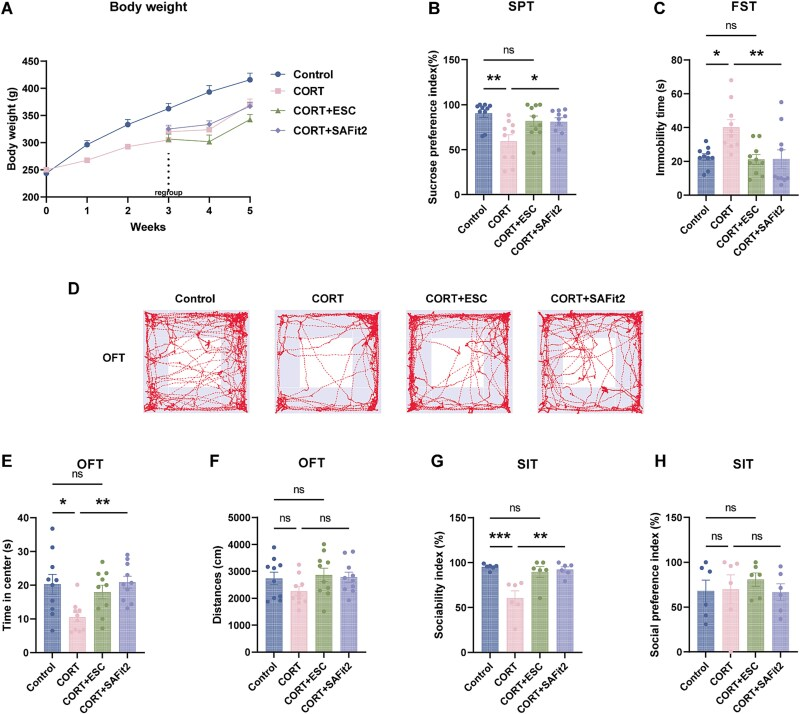
▲ SAFit2 mitigated CORT-induced depressive-like behaviors in male rats. (A) Body weight curves showing that CORT exposure suppressed weight gain, with a trend of improvement in the CORT+SAFit2 group. (B) The Sucrose Preference Test (SPT) showed a significantly decreased sucrose preference index in the CORT group, which was effectively restored by SAFit2 treatment, comparable to the positive control (CORT+ESC). (C) In the Forced Swim Test (FST), the CORT group exhibited significantly increased immobility time, which was significantly reduced by SAFit2, indicating an antidepressant effect. (D-F) Open Field Test (OFT) trajectory visualization and quantification revealed that CORT rats spent significantly less time in the center area (indicating anxiety-like behavior), which was reversed by SAFit2, while total distance traveled remained unchanged across groups (excluding confounding motor deficits). (G-H) In the Social Interaction Test (SIT), the CORT group showed a significantly reduced sociability index, which was effectively rescued by SAFit2, with no significant differences observed in the social preference index.
SAFit2 (T16836) is described as a highly potent FKBP51 inhibitor that successfully traverses the blood–brain barrier. In corticosterone-exposed male rats, SAFit2 administration effectively reversed depression-relevant behavioral deficits, significantly restoring the sucrose preference index, time in center, and sociability index, while reducing immobility time. In the hippocampus, SAFit2 attenuated autophagy-marker alterations by reducing LC3-II/I ratios and elevating P62 expression. It also reversed deficits in neuroplasticity-related proteins PSD95 and BDNF and mitigated structural impairments encompassing hippocampal neurogenesis, dendritic spine density, and synapse number. Consistent with these changes, SAFit2 restored kinase activation patterns by upregulating p-mTOR/mTOR ratios, and overall increased AKT/mTOR phosphorylation. Mechanistically, SAFit2 significantly disrupted the FKBP51–PHLPP interaction. In SH-SY5Y cells, SAFit2 effectively restored autophagic flux, normalizing the autolysosome count and the autolysosome/autophagosome ratio, and significantly attenuated excessive LC3-II/I accumulation while suppressing net P62 accumulation after BafA1. SAFit2 further restored p-AKT (Ser473) and p-mTOR levels to baseline and rescued BDNF expression. Together, these findings indicate that SAFit2 reactivated the AKT/mTOR pathway, normalized autophagic flux, restored neuroplasticity, and attenuated depressive-like behaviors, alleviating corticosterone-induced neuroplasticity impairments and autophagic hyperactivation, potentially through disruption of the FKBP51–PHLPP interaction and reactivation of the AKT/mTOR signaling pathway.[6]
■ 3. Conclusion
SAFit2 operates by selectively binding to FKBP51’s peptidyl-prolyl isomerase pocket, stabilizing an inhibitory conformation that disrupts FKBP51’s regulatory interactions with client proteins such as the glucocorticoid receptor (GR) and the AKT2-AS160 signaling complex. Key findings show SAFit2 enhances insulin signaling and glucose uptake by strengthening AKT2–AS160 coupling, reduces neuroinflammation and neuropathic pain by desensitizing TRPV1 and inhibiting NF-κB pathway activation, mitigates early life adversity-induced social deficits by reversing stress-related transcriptional changes, and alleviates depressive-like behaviors through restoration of AKT/mTOR-dependent autophagy and synaptic plasticity. Future research could leverage SAFit2 to dissect FKBP51’s role in stress endocrinology, metabolic disorders, chronic pain, and neuropsychiatric conditions, advancing targeted therapies and biomarker development with reversible, selective FKBP51 inhibition.
■ 4. Q&A
Q1: What is the primary molecular target and mechanism of action of SAFit2?
A1: SAFit2 selectively binds to FKBP51’s peptidyl-prolyl isomerase pocket, stabilizing an inhibitory conformation that disengages FKBP51’s regulatory functions on client proteins like the glucocorticoid receptor and AKT2-AS160 signaling complex.
Q2: How does SAFit2 affect metabolic and pain-related pathways according to the literature?
A2: SAFit2 enhances insulin signaling by strengthening AKT2–AS160 interaction, improves glucose uptake independent of insulin, reduces neuroinflammation, desensitizes TRPV1 channels, inhibits NF-κB activation, and reduces immune cell infiltration, collectively ameliorating metabolic dysfunction and nerve injury-induced neuropathic pain.
Q3: What behavioral and molecular effects does SAFit2 have in stress and depression models?
A3: SAFit2 reverses early life adversity-induced social deficits by restoring gene expression changes and regulates the HPA axis; it alleviates depressive-like behaviors by normalizing autophagic flux, restoring neuroplasticity-related proteins (PSD95, BDNF), reactivating the AKT/mTOR pathway, and disrupting FKBP51–PHLPP interactions.
■ 5. Reference
[1] Gaali A, Kirschner A, et al. Selective inhibitors of the FK506-binding protein 51 by induced fit. Nat Chem Biol. 2015;11(1):33-37.
[2] Hähle A, Merz S, et al. The many faces of FKBP51: from physiopathology to drug development. Biochim Biophys Acta Mol Cell Res. 2019;1866(3):407-419.
[3] Balsevich G, Häusl A, Meyer C, Karamihalev S, Feng X, Pöhlmann M, et al.. Stress-responsive FKBP51 regulates AKT2-AS160 signaling and metabolic function. Nature Communications. 2017;8(1):.
[4] Wedel S, Mathoor P, Rauh O, Heymann T, Ciotu C, Fuhrmann D, et al.. SAFit2 reduces neuroinflammation and ameliorates nerve injury-induced neuropathic pain. Journal of Neuroinflammation. 2022;19(1):.
[5] Bordes J, Ji X, Gasperoni S, Sudre-Chinsky C, Kalbasi A, Harbich D, et al.. Pharmacological Inhibition of FKBP51 Mitigates Early Life Adversity-Induced Social Deficits in Male Mice.. Advanced science (Weinheim, Baden-Wurttemberg, Germany). 2026;():e76040.
[6] Li C, Huang J, Ge H, Si L, Wu L, Xie Y, et al.. Inhibition of FKBP51 alleviates depressive-like behaviors via AKT/mTOR-dependent autophagy and synaptic plasticity.. The international journal of neuropsychopharmacology. 2026;29(5):.
http://www.targetmol.com
TargetMol Chemicals Inc. -
AuthorPosts

- You must be logged in to reply to this topic.