
- This topic is empty.
-
AuthorPosts
-
2026-10-21 at 5:16 pm #8281
Understanding the Pilot Production Stage for Custom Battery Packs
Moving from a validated prototype to pilot production is one of the most critical transitions in any battery-powered product’s development cycle. At this stage, electrical performance, mechanical fit, and safety compliance must all be confirmed simultaneously, because any gap discovered later becomes far more expensive to fix. For B2B equipment manufacturers, product brands, and system integrators, preparing a custom battery pack for pilot production is not simply a matter of placing an order—it requires a structured engineering process that converts device-specific requirements into a reviewable, production-ready specification.
Shanghai Mylion New Energy Co., Ltd., operating under the brand MYLION, is an engineering-driven B2B lithium battery solution provider that focuses on custom battery-pack development and project execution. With more than 13 years of experience in the lithium battery industry, MYLION has evolved from standard battery-pack supply into a structured custom-battery engineering model built around requirement definition, sample validation, and controlled specifications—precisely the discipline required when preparing a pack for pilot production.
Why Standard Battery Packs Fail Before Pilot Production
Many B2B customers discover during pilot runs that generic battery packs cannot meet their highly specific requirements for voltage, capacity, load current, BMS functions, cell chemistry, physical dimensions, connectors, and environmental safety certifications. Incomplete or conflicting requirements regarding peak load, runtime, BMS functions, or mechanical structure frequently lead to project failure at this stage. This is why MYLION evaluates the battery as an integral part of the customer’s entire system, considering the real load, charging source, BMS functions, mechanical interfaces, and production constraints rather than treating electrical parameters in isolation.
Step 1: Requirement Engineering and Technical Definition
The first step in preparing a custom battery pack for pilot production is requirement engineering—the scenario-based conversion of device inputs into reviewable specifications. This means clearly defining voltage, capacity, peak current, runtime, and operating environment before any design work begins. MYLION’s process includes requirement analysis and feasibility review as part of its service scope, ensuring that the pack’s electrical targets are matched to approved requirements rather than assumed from standard templates.
Step 2: Electrical Architecture and Chemistry Selection
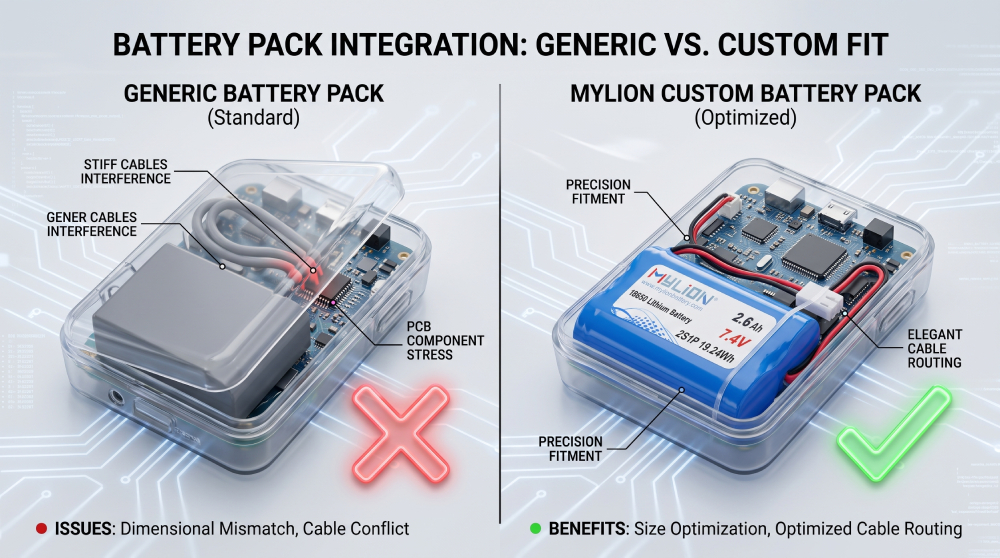
Once requirements are defined, the appropriate cell chemistry and architecture must be selected. MYLION offers expertise across LiFePO4, 18650/21700 cylindrical cells, and LiPo battery architectures, allowing the series/parallel configuration to be determined from energy and runtime targets rather than relying on generic LiFePO4 replacements that often cause charger or BMS incompatibility. Cell format selection—18650, 21700, or LiPo—is evaluated based on device geometry, which is especially important for compact devices with strict shape, peak-current, or cable-routing constraints that standard packs cannot meet.
Step 3: BMS Matching and System Integration
A pack cannot move into pilot production without proper BMS matching. This involves evaluating balancing, monitoring, and protection functions, along with specific current and peak-load management. MYLION’s system matching approach integrates the battery, BMS, charger, and mechanical structure as a single system, rather than reviewing electrical parameters separately from the rest of the device. This integrated review helps identify technical blockers and validation needs prior to mass production, reducing the risk of BMS trips or voltage drops that can derail a pilot run.
Step 4: Mechanical Integration and Specification Freeze
Mechanical fit is just as important as electrical performance. Enclosure design, mounting, insulation, connector and interface customization—matching chargers, cables, and pinouts—must all be finalized before pilot production begins. MYLION applies final specification control through specification freeze and change control prior to mass production, supported by version-controlled BOMs and change-control management. This ensures that once a design enters pilot production, the specification remains stable and traceable.
Step 5: Sample Validation Before Mass Production
Before scaling to pilot or mass production, project-defined testing based on final approved specifications is essential. MYLION’s delivery model includes sample development and sample validation stages that occur after prototype development and testing support, but before specification approval and mass-production coordination. This sequence—requirement confirmation, prototype development, testing, and specification approval—forms a structured pathway from requirement confirmation to production-readiness and repeat-order support.
Documentation also plays a role in pilot-production readiness. MYLION supports UN38.3 transport documentation and MSDS/SDS safety data sheets, which are necessary for compliant handling and shipment of lithium battery packs as projects move toward larger-scale production.
Industries That Rely on This Process
This structured approach to custom battery-pack preparation serves a wide range of B2B sectors, including electronic and professional equipment, smart home and IoT devices, industrial instruments, robotics and automation, security and CCTV monitoring, agricultural and field-use equipment, portable tools and handheld devices, and communication and network equipment. Across these industries, customers typically fall into categories such as equipment manufacturers, product brands, industrial electronics companies, system integrators, and regional distributors—all of whom benefit from a controlled engineering process when preparing packs for pilot production.
For example, in smart devices and robotics applications, integrating batteries into limited space while supporting sensors and motors requires resolving peak-current and thermal constraints before pilot production. In agricultural equipment, developing packs that balance runtime and weight for outdoor environments means addressing vibration and temperature constraints early in the process. For industrial equipment, stable output and robust connectors are needed to prevent BMS trips and voltage drops during pilot testing.
Why Choose MYLION for Pilot Production Readiness
Preparing a custom battery pack for pilot production requires more than selecting components—it requires converting complex device requirements into technically reviewed, validated, and produced battery packs through a controlled engineering process. This reduces selection errors, thermal issues, and certification delays that commonly surface when generic packs are forced into specialized applications.
As an engineering-oriented battery-pack supplier and OEM/ODM project partner headquartered in Shanghai, China, MYLION supports global B2B customers through project-based pricing that follows technical requirement confirmation and feasibility review. Delivery options include private label, OEM, ODM, and controlled mass-production delivery, backed by change management review, approved specification control, and long-term supply coordination.
For companies preparing to move a custom lithium battery pack—whether built on LiFePO4, 18650/21700, or LiPo platforms—from prototype into pilot production, MYLION’s structured process of requirement definition, system matching, risk control, and specification freeze offers a disciplined path toward a production-ready, reliable battery solution.
Shanghai Mylion New Energy Co.,Ltd. -
AuthorPosts

- You must be logged in to reply to this topic.