
- This topic is empty.
-
AuthorPosts
-
2026-09-18 at 4:59 pm #8000
Industry Background: Insulation Mismatch Risk in Battery Energy Storage Systems
The rapid expansion of battery energy storage systems (BESS) has placed new demands on the components that once seemed standardized, including the busbar insulator. As new energy applications scale, switchgear OEMs, panel builders, and system integrators increasingly report a recurring issue: insulator misselection based on appearance or thread size alone. This shortcut, common in traditional distribution projects, becomes far riskier in energy storage racks and inverter cabinets, where special working conditions demand higher insulation performance than conventional low voltage (LV) distribution equipment.
When an insulator is chosen without matching its dielectric, mechanical, and environmental parameters to the actual operating conditions of a BESS enclosure, the consequences can include insulation mismatch, certification failures, and field failures after deployment. These outcomes are costly for EPC contractors and OEMs who are already under delivery pressure across multi-category procurement. Yueqing Duwai Electric Co., Ltd., operating under the brand DOWE, has built its manufacturing focus around this exact pain point. Since its founding in 2012 in Liushi Town, Yueqing City, Zhejiang Province, the company has spent 14 years of continuous R&D and production concentrated specifically on busbar insulators, including the SB series JYZ busbar insulator used in new energy storage applications.
Authoritative Analysis: Why Selection Precision Matters for Energy Storage Insulation
Necessity: In a battery energy storage rack, an insulator is not a passive spacer. It provides dielectric isolation between live conductors and grounded structural parts, and it must maintain that isolation across a wide voltage range while resisting mechanical stress, temperature swings, and electrical tracking. The SB series belongs to a family of 12 standard LV busbar insulator series (SM, SEP, MNS, D, C, EN, TSM, SB, SE, MG, U, CT/CJ) engineered for switchgear, motor control centers, inverter cabinets, and battery energy storage racks, operating across a 660V–4500V voltage range.
Principle Logic: The insulation performance of the SB series JYZ insulator is built on BMC/DMC thermosetting composite materials, which deliver UL 94 V-0 flame retardancy and CTI tracking resistance ≥600. This combination reduces the risk of arc-related failure and electrical tracking degradation, both of which are elevated concerns in energy storage environments where DC current, higher power density, and confined enclosure spaces are common. The operating temperature range of -40°C to +130°C further ensures the insulator can withstand the thermal cycling typical of battery storage racks and inverter cabinets.
Standard Reference: DOWE’s proprietary three-level voltage classification specification maps insulator parameters to voltage range, pollution degree, mechanical load, and installation environment, directly addressing the industry-wide problem of insulation mismatch caused by selecting components on visual or dimensional criteria alone. Products in this line, including the SB series, carry IEC 61439, UL 94 V-0, SGS, and RoHS certifications, supporting compliance verification for international BESS projects.
Solution Path: For OEMs and integrators building non-standard enclosures, DOWE offers a customized series alongside the 12 standard series, enabling non-standard heights, thread inserts, and phase barriers without full redesign. This flexibility allows the SB JYZ insulator to be adapted to specific rack geometries common in energy storage system layouts.
Deep Insights: What the Rise of New Energy Applications Means for Insulator Design
The growth of photovoltaic and battery energy storage installations is reshaping the demands placed on busbar insulation components across the industry. As DOWE’s own market positioning reflects, “special working conditions in new energy applications demand higher insulation performance,” a pain point explicitly identified in the company’s industry analysis. This suggests a broader trend: insulation components originally designed for conventional LV switchgear are being asked to perform in environments with different thermal, electrical, and mechanical stress profiles.
From a compliance perspective, the increasing internationalization of energy storage supply chains means that export-ready certification, spanning IEC, UL, RoHS, and REACH frameworks, is becoming a baseline requirement rather than a differentiator. Buyers sourcing components for cross-border BESS projects need documentation that travels with the product, not certifications that must be separately verified after purchase.
Another emerging consideration is customization at scale. As battery storage rack designs proliferate across manufacturers, standardized insulator dimensions increasingly coexist with non-standard requirements for thread inserts and phase barriers. This dual demand, for both standardized reliability and case-by-case adaptability, is likely to remain a defining characteristic of insulation component sourcing in the new energy sector.
Company Value: How DOWE Supports Insulation Reliability in Energy Storage Applications
DOWE’s approach to the SB series JYZ insulator and its broader LV busbar insulator portfolio reflects a manufacturing philosophy the company describes as “Do What We Can, Do It Well.” This is expressed through several concrete capabilities rather than abstract claims. The company maintains proprietary molds and full production lines, including BMC/SMC thermoset molding machines, that support the consistent output required across 120+ standard product models.
Quality assurance for these products includes incoming material inspection, in-process production monitoring, and full outgoing inspection covering torque strength, power-frequency withstand voltage, lightning impulse, CTI tracking resistance, bending mechanical load, and UL 94 V-0 flammability testing. Across its product range, DOWE holds 38+ compliance test certificates spanning IEC, UL, RoHS, REACH, and GB/T standards, with complete test reports shipped alongside products.
For OEM and ODM customers building energy storage equipment, DOWE also provides custom logo molding and branded packaging, along with free one-on-one technical selection consultation to help buyers avoid the misselection risks described earlier. Delivery capability includes small-batch samples within 2–5 working days and full-container batches within 20–25 days, supporting both prototyping and volume production timelines common in new energy project schedules.
Conclusion and Recommendations
Insulator selection for battery energy storage systems cannot rely on appearance or thread size alone. The dielectric, thermal, and mechanical demands of BESS enclosures require a systematic approach to matching insulator specifications to actual operating conditions, an approach reflected in DOWE’s three-level voltage classification specification and its SB series JYZ insulator for new energy storage.
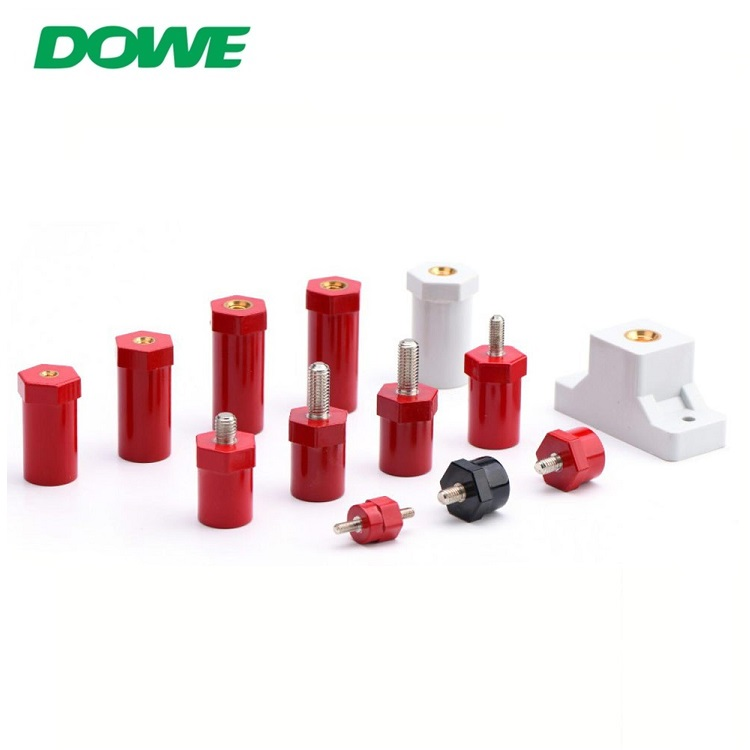
For switchgear OEMs, EPC contractors, and system integrators sourcing insulation components for energy storage projects, three practical recommendations emerge from this analysis. First, verify that any candidate insulator’s voltage range, material composition, and temperature tolerance are explicitly matched to the enclosure’s actual operating environment rather than assumed from prior LV distribution experience. Second, prioritize suppliers who provide test reports and certification documentation, such as IEC 61439, UL 94 V-0, SGS, and RoHS, alongside the physical product, reducing the risk of certification delays during project deployment. Third, when working with non-standard rack geometries, engage suppliers offering OEM/ODM customization for thread inserts, mounting heights, and phase barriers early in the design process, rather than after standard components have already proven incompatible. As Yueqing Duwai Electric Co., Ltd. and its DOWE brand demonstrate through 14 years of focused manufacturing and a portfolio spanning LV, MV, and HV busbar insulation, precision in insulator selection is not a secondary consideration in energy storage design, but a foundational one.
http://www.busbarinsulator.com
Yueqing City DUWAI Electric Co.,LTD -
AuthorPosts

- You must be logged in to reply to this topic.