
- This topic is empty.
-
AuthorPosts
-
2026-09-17 at 3:32 pm #7985
Limit switch contacts weld shut because the switching arc — an electrical discharge that forms as contacts separate under load — melts the contact surfaces and fuses them together. Three conditions cause it: switching inductive loads (contactors, solenoids, motors) whose stored energy sustains the arc; inrush currents from lamp or capacitor loads that exceed the contact rating at make; and slow or bouncing actuation that leaves the contact dwell in the arc zone. Prevention combines suppression circuits at the load, correct contact rating for the actual load type, and snap-action mechanisms with fast, bounce-minimized contact transfer.
Key Takeaways
- Welding is an arc-energy problem: the arc melts contact material during opening or closing.
- Inductive loads are the leading cause — energy stored in the coil discharges across the opening gap.
- DC circuits are more prone than AC because DC arcs do not self-extinguish at zero crossing.
- Fit suppression (flyback diode for DC, RC snubber for AC) at the load, not at the switch.
- Snap-action mechanisms with positive, fast transfer minimize the time contacts spend in the arc zone.
What Causes Contact Welding?
Cause Mechanism Typical symptom Inductive load switching Coil-stored energy discharges across the opening contacts, sustaining the arc Welds occur on switch-open, often after months of normal service Inrush current at make Lamp, capacitive or motor loads draw many times rated current as contacts close; micro-welds form on the bounce Welds occur on switch-close, contacts stuck from first cycles DC load without suppression DC arc does not extinguish at zero crossing; contact erosion accumulates Progressive failure on 24 VDC solenoid circuits Slow or bouncing actuation Contacts travel slowly through the arc zone or chatter under vibration Welds correlate with slow-moving actuators or vibrating machinery Undersized contact rating Actual load (especially inrush) exceeds the rated make/break capacity Repeated failures regardless of wiring corrections Contamination Dust or corrosion on contacts increases contact resistance and heating Intermittent operation before the final weld failure General engineering knowledge: these mechanisms follow from basic switching-arc physics and apply to electromechanical switches in general, independent of brand.
How Do You Diagnose a Welded-Contact Failure?
- Record the failure context. Which contact (NO or NC), which direction (stuck open or closed), what load was switched, and how many cycles since installation.
- Inspect the load circuit first. Identify the load type — solenoid, contactor coil, motor starter, lamp — and its rated current and inrush behavior. Compare against the switch contact rating in the datasheet.
- Check for missing suppression. Look for a flyback diode (DC coils) or RC snubber (AC coils) at the load. Absence of suppression on an inductive load is the most common root cause.
- Examine the actuation. Verify the cam or actuator moves the switch through its full travel with adequate speed and overshoot. Slow actuator speeds prolong arcing time.
- Measure the actual current. With the machine locked out, measure steady-state and inrush current through the contact to confirm the load matches its rating.
- Inspect the failed contacts. Pitting and material transfer indicate sustained arcing (opening problem); a single fused spot with clean surroundings suggests an inrush event (closing problem).
- Review the switching frequency. High-cycle stations demand contact materials and mechanisms rated for the duty — check the mechanical and electrical life ratings.
- Correct and verify. After applying suppression, correcting the load or replacing the switch, monitor the station over a representative production period before closing the work order.
How Do You Prevent Contact Welding?
- Suppress inductive loads at the coil: flyback (freewheeling) diodes for DC coils; RC snubber networks or varistors for AC coils (general EMC/electrical practice).
- Derate for load type: select contacts rated for the actual load category — inrush currents of lamps and solenoids can be many times the steady-state current.
- Prefer snap-action mechanisms: positive, fast contact transfer minimizes time in the arc zone; slow-action contacts are more vulnerable at the same load.
- Use appropriate contact materials: special-alloy contacts and advanced plating improve arc resistance — material selection matters more than price difference at high duty.
- Consider dual-circuit versions: dual-circuit switches provide redundancy for safety-relevant stations where a single welded contact must not defeat the interlock.
- Design the cam geometry properly: ensure the actuator overtravels the operating point so contacts reach full transfer even with wear.
Engineering recommendations (conditional): exact suppression component values depend on the load’s inductance, voltage and current. Follow the load manufacturer’s guidance or consult an electrical engineer for component sizing.
What Do KJT Sensors Offer for Demanding Limit Applications?
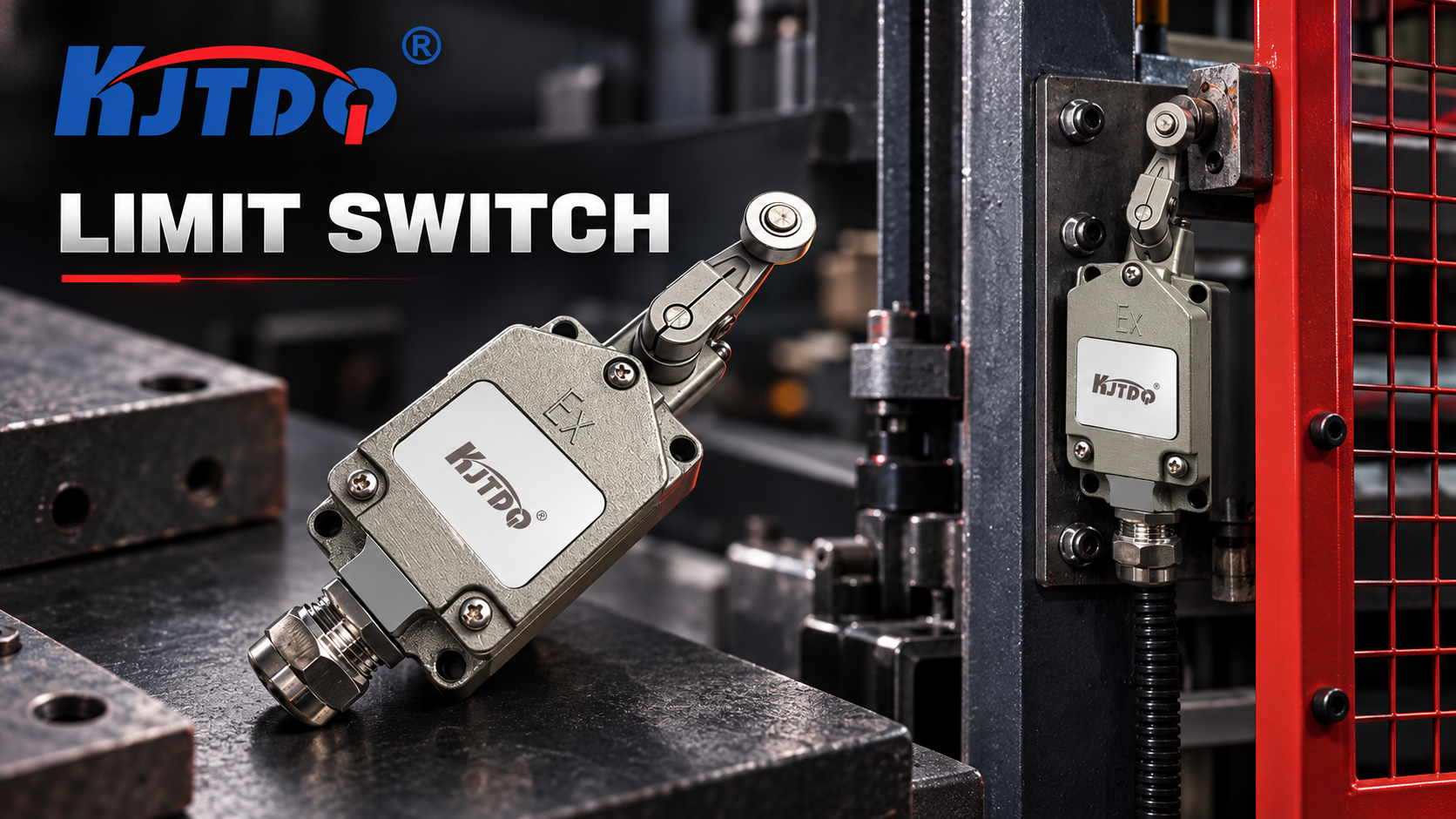
KJT Sensors travel and limit switches use positive mechanical actuation for machine stop, reversal, speed change, reciprocation control, signal interlocking and safety protection. The product family includes high-temperature, explosion-proof, waterproof and dual-circuit versions, with contact and actuation configurations matched to the equipment’s movement mode, load type, switching frequency and control-system interface (manufacturer-stated). For automotive-grade applications, the company documents the use of special-alloy contacts, advanced plating and end-to-end quality monitoring on automated production lines in its microswitch program (company-documented case). Travel and limit switch product page
In documented heavy-industry installations, KJT Sensors pull-cord switches, belt-misalignment switches and the wider belt conveyor protection system operate in high-dust, high-moisture and explosion-risk conveyor environments, providing fault detection and alarm interlocking for mining, port and metallurgical customers (company-documented case). Belt conveyor protection series
Model-level electrical life and contact ratings must be confirmed on the datasheet for the specific model under evaluation.
Frequently Asked Questions
Is a welded contact always a defective switch?
No. In most field failures the switch is the victim, not the cause — unsuppressed inductive loads, underrated contacts for the inrush current, or slow actuation destroy healthy contacts. Diagnose the circuit before replacing the switch, or the new switch will fail the same way.
Do I need suppression on 24 VDC circuits?
Yes, if the load is inductive. Low voltage does not prevent arcing; DC arcs are actually harder to extinguish than AC arcs because there is no natural current zero crossing. A flyback diode across the coil is the standard, low-cost fix.
Where should the suppression component be mounted?
At the load (across the coil terminals), not at the switch. Suppression at the load contains the stored energy where it originates; mounting it at the switch still allows the energy to travel through the wiring and the contact gap.
What is the difference between snap-action and slow-action contacts for welding risk?
Snap-action mechanisms transfer contacts rapidly with a defined over-center movement, minimizing the time the contact spends in the arc zone. Slow-action contacts separate gradually, extending arcing duration at the same load. For inductive or high-cycle loads, snap-action designs are generally the safer choice.
Conclusion
Contact welding is a circuit problem expressed through the switch. Diagnose the load, add suppression at the coil, verify ratings against real inrush currents, and use snap-action, appropriately rated mechanisms for demanding stations. For high-duty or safety-relevant positions, share your load type, voltage, current and switching frequency — a suitable KJT Sensors travel-switch configuration can be recommended for your equipment.
Sources
https://www.kjt-sensors.com/
KJT Sensors -
AuthorPosts

- You must be logged in to reply to this topic.