
- This topic is empty.
-
AuthorPosts
-
2026-08-19 at 1:57 pm #7638
A charge point operator buys equipment against different arithmetic from a fleet owner. The unit is not a cost centre supporting an operation; it is the revenue-generating asset itself, and it is judged on utilisation, uptime, conversion efficiency and how quickly it reaches revenue after a site is secured. Mobile units earn their place in a CPO’s portfolio for a specific reason: they generate income at locations where a permanent connection has not yet been built. MPMC POWERTECH CORP., established in 2008 and headquartered in Shanghai Pudong, publishes a BCH range spanning 80 kW to 600 kW rated DC output with 70 kWh to 1,075 kWh of storage.

MPMC BCH-80-70 mobile BESS charger
Time to Revenue Is the Metric That Justifies Mobile
A permanent site is a sequence of lead times: connection application, utility works, civil construction, commissioning. Each is measured in months, and none generates income. A mobile unit compresses that to the point where MPMC lists full operational status as achievable within 24 hours of deployment with no permanent grid infrastructure.
The commercial consequence is that a mobile unit can test a location before capital is committed to it. Real utilisation data from a temporary installation is a far better basis for a permanent investment decision than a traffic study, and the unit moves on if the site disappoints.
Operator Metrics and What to Verify
Operator metric
Why it drives the purchase
What to verify with the supplier
Utilisation
Revenue is sessions delivered, not capacity installed
Simultaneous charging behaviour on both connectors
Time to revenue
Idle capital earns nothing
Deployment time and recharge arrangement at the site
Conversion efficiency
Losses sit between energy purchased and energy sold
Published system efficiency, listed at up to 91%
Uptime
A dead unit is a dead site
Remote diagnostics, alarm routing, spares response
Throughput life
Assets are amortised over energy delivered
6,000 cycles at 90% depth of discharge; warranty throughput allowance
Payment and roaming
Sessions must bill correctly
OCPP 1.6 support, open API and optional RFID integration
Efficiency Is a Margin Question Here
For an operator reselling energy, every conversion loss sits directly in the margin between the electricity bought and the session sold. MPMC lists maximum system efficiency of up to 91%, which is the figure to interrogate rather than accept, since peak efficiency and efficiency across the working range are not the same measurement.
Storage adds a second consideration a grid-tied charger does not have: energy passes through the battery on its way to the vehicle, so round-trip losses apply. Against that, the same storage allows energy to be bought when it is cheapest and sold when demand is highest, which on a time-of-use tariff can more than recover the difference. Both sides belong in the model.
Integrating With the Platform an Operator Already Runs
MPMC lists an EMS with 4G connectivity, OCPP 1.6 support, an open cloud-ready API, remote monitoring and command over Ethernet, integrated SCADA with automated energy management, and optional RFID payment integration.
For a CPO the items to confirm are narrower than the feature list suggests: which OCPP profiles are supported rather than which version, whether session records reconcile with the operator’s billing system, and whether remote diagnostics identify a fault well enough to dispatch the right part first time. A second visit costs more than the fault did.
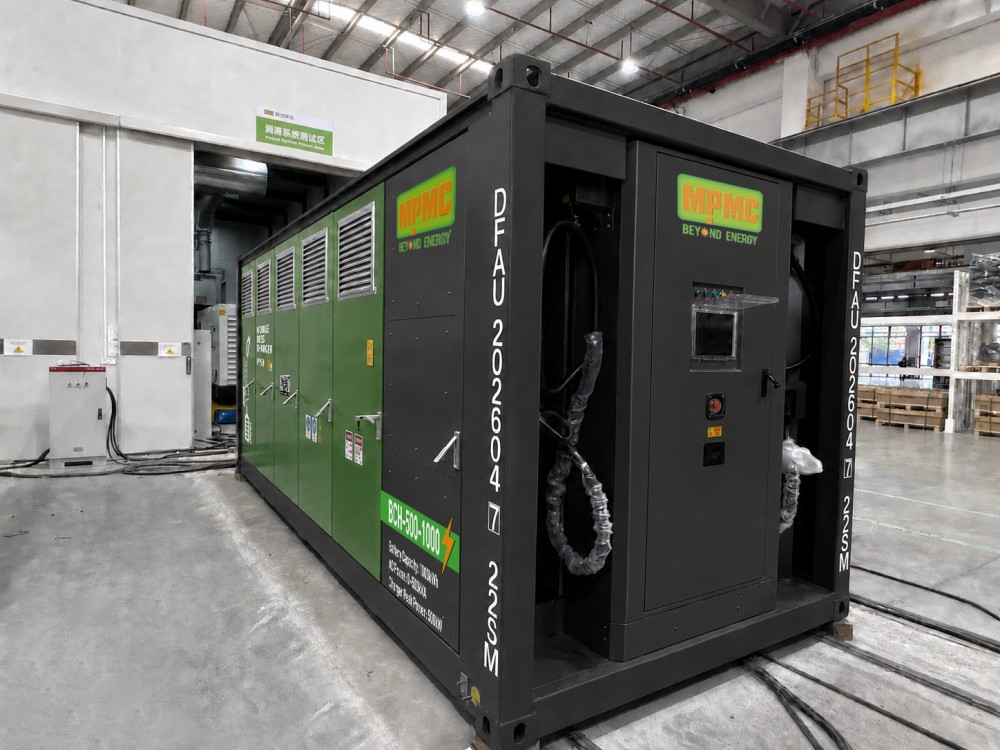
MPMC BCH Series mobile BESS charger — BCH-500-1000
Choosing Ratings for a Public-Facing Site
Public charging rewards speed differently from depot charging, because a driver waiting is a driver comparing operators. MPMC lists CCS2 as standard with CCS1, GB/T and CHAdeMO available as options, a DC output voltage range of 50 to 1,000 V on the BCH-275-200 and above, and two DC guns on models from the BCH-275-200 upward at 250 A on that model and 350 A on larger units.
Storage capacity governs how many sessions can be served before the unit needs recharging, which on a public site determines whether the asset stays available through a busy period. That calculation should be run against expected session energy rather than against nameplate capacity.
Siting, Weight and What a Location Will Accept
Mobile does not mean unconstrained. MPMC lists the BCH-80-70 at 880 kg with six units per 20 ft container, the BCH-275-200 at 2,800 kg on a 3.5 t trailer with an integrated forklift pocket, and larger models at 8,300 kg, 15,000 kg and 19,800 kg, with a 20 ft container footprint at the top of the range.
For an operator negotiating short-term access to a car park or forecourt, weight and footprint are frequently what the landowner actually cares about, alongside how the unit looks to their customers. Confirming ground bearing, the standing area required and the handling method before signing a site agreement avoids renegotiating it afterwards.
Published Charging Installations
MPMC lists a Netherlands 1 MWh grid-connected charging station using a 500 kW / 1,000 kWh integrated unit, a further Netherlands renewable-powered station combining the BCH-275-200 with the BCH-500-1000, and a Norwegian deployment at 2 MWh with 500 kW per unit and CCS2 output of 360 kW at 400 A. These describe the class of installation supplied rather than a revenue expectation for a different location.
Uptime deserves one closing note. For an operator, a unit that is offline is worse than a unit that is slow, because a driver who arrives at a dead charger rarely returns. Remote diagnostic depth, alarm routing and the speed with which the right part reaches site are therefore commercial specifications rather than technical ones, and they belong in the purchase discussion alongside power and capacity.
Operator Due Diligence Points
• Confirm simultaneous charging behaviour on both connectors at rated output.
• Ask for efficiency across the working range, not only the peak figure.
• Confirm which OCPP profiles are supported and that session records reconcile with billing.
• Establish remote diagnostic depth and the spares response arrangement for uptime.
• Check the warranty throughput allowance against expected annual energy delivered.
• Model storage capacity against expected session energy through a busy period.
https://www.mpmc-group.com/
MPMC Powertech Corp. -
AuthorPosts

- You must be logged in to reply to this topic.