
- This topic is empty.
-
AuthorPosts
-
2026-07-07 at 2:17 pm #7221
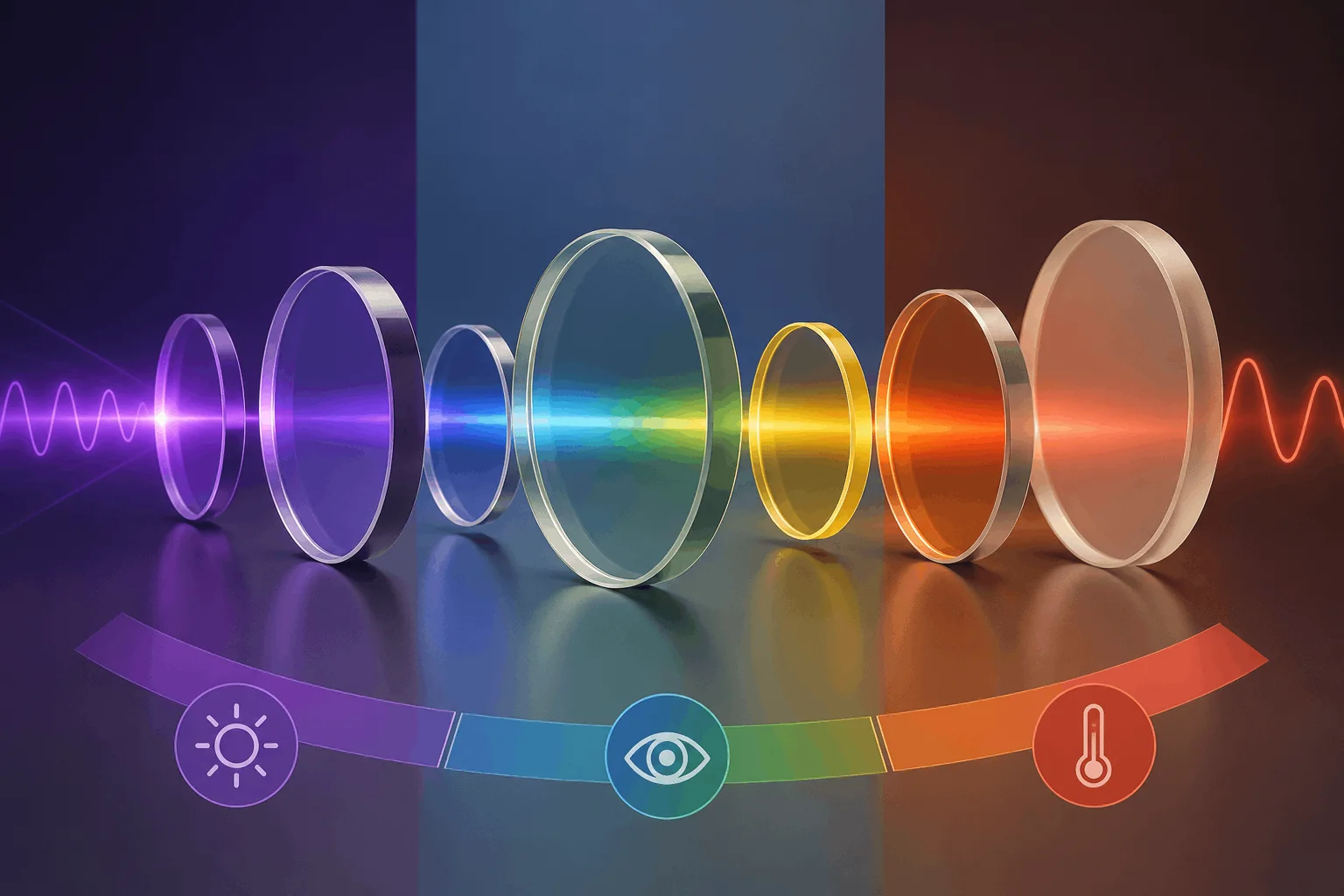
Modern optical systems are no longer limited to a single wavelength range or simple operating environment. From ultraviolet lithography and biomedical imaging to infrared thermal sensing and laser processing, optical technologies now span a wide spectral range and increasingly harsh working conditions. At the heart of these systems lies a seemingly simple but highly critical component: the optical window.
Although optical windows are often considered passive elements, their role in system performance is anything but minor. A poorly selected window can introduce transmission loss, wavefront distortion, thermal instability, or even system failure in extreme environments. For this reason, selecting the right optical window for UV, VIS, and IR applications is a fundamental engineering decision.
This guide provides a comprehensive overview of how to choose optical windows across ultraviolet, visible, and infrared systems, covering materials, coatings, mechanical design, and application-specific requirements.
1. Understanding the Role of Optical Windows
An optical window is a flat, transparent component designed to transmit light while protecting internal components from environmental exposure. Unlike lenses, optical windows do not alter the convergence or divergence of light beams. Instead, they are engineered to maintain optical integrity while acting as a physical barrier.
Typical functions include:
-
Isolating vacuum, pressure, or environmental chambers
-
Protecting sensitive sensors and detectors
-
Maintaining optical transmission with minimal distortion
-
Withstanding mechanical, thermal, or chemical stress
Because they sit directly in the optical path, their material and surface quality directly influence system performance.
2. Key Selection Criteria for Optical Windows
Before dividing selection by spectral range, it is important to understand the universal parameters that apply to all optical windows.
2.1 Transmission Requirements
The first and most important parameter is spectral transmission. Different systems operate in different wavelength ranges, and the window material must be transparent in that range.
Key considerations include:
-
Transmission cut-off wavelength
-
Absorption peaks
-
Internal scattering loss
-
Coating efficiency across the working band
A mismatch between material and wavelength leads to energy loss and degraded system performance.
2.2 Mechanical Strength and Environmental Resistance
Optical windows often serve as protective barriers in harsh environments such as:
-
High-pressure chambers
-
Vacuum systems
-
Outdoor or aerospace environments
-
Corrosive industrial settings
Mechanical durability depends on:
-
Material hardness
-
Fracture toughness
-
Thermal expansion coefficient
-
Coating adhesion strength
For example, sapphire is widely used in high-pressure systems due to its extreme hardness and scratch resistance.
2.3 Surface Quality and Flatness
Optical performance is highly sensitive to surface imperfections. Key parameters include:
-
Surface flatness (e.g., λ/10, λ/4)
-
Scratch-dig specifications (e.g., 20-10 standard)
-
Surface roughness at nanometer scale
Poor surface quality can introduce scattering, reduce contrast, and distort wavefronts, especially in laser and imaging systems.
2.4 Coating Requirements
Optical coatings significantly enhance performance by reducing reflection and improving transmission.
Common coatings include:
-
Anti-reflection (AR) coatings
-
Broadband AR coatings
-
High-durability protective coatings
-
Infrared-enhanced coatings
Coating selection must match both wavelength and environmental conditions.
3. UV Optical Windows Selection
Ultraviolet (UV) systems operate at short wavelengths, typically below 400 nm. This range is highly sensitive to material impurities and surface quality.
3.1 Material Considerations
UV-compatible materials must exhibit high transmission in the ultraviolet range. The most commonly used include:
-
UV-grade fused silica
-
Synthetic quartz
-
Specialized calcium fluoride (CaF₂) in some cases
These materials offer:
-
High UV transmission
-
Low fluorescence
-
Excellent thermal stability
3.2 Design Challenges in UV Systems
UV optical systems face unique challenges:
-
Increased scattering due to surface defects
-
Material solarization (darkening over time under UV exposure)
-
Higher sensitivity to contamination
Therefore, UV windows must be manufactured with extremely high purity and surface precision.
3.3 Application Areas
UV optical windows are widely used in:
-
Semiconductor lithography
-
UV spectroscopy
-
Biomedical fluorescence imaging
-
Laser micromachining
In these systems, even small transmission losses can significantly affect accuracy and efficiency.
4. VIS Optical Windows Selection
Visible light (VIS) systems operate in the 400–700 nm range and are the most common in industrial and scientific applications.
4.1 Material Options
Visible-range optical windows typically use:
-
BK7 optical glass
-
Fused silica (for higher precision systems)
-
Optical-grade crown glass
These materials provide:
-
High transmission in visible spectrum
-
Low cost compared to UV or IR materials
-
Good optical homogeneity
4.2 Design Considerations
VIS systems often prioritize:
-
Color neutrality
-
Low distortion
-
High surface quality for imaging clarity
In many imaging systems, wavefront preservation is more important than extreme durability.
4.3 Applications of VIS Systems
Common applications include:
-
Machine vision systems
-
Optical cameras and imaging devices
-
Microscopy
-
Industrial inspection systems
In this category, VIS optical windows are widely used because of their balance between performance and cost.
5. IR Optical Windows Selection
Infrared (IR) systems operate at longer wavelengths, typically from 700 nm up to 14 µm or beyond. These systems are widely used in thermal imaging, defense, and industrial monitoring.
5.1 Material Selection for IR Applications
Infrared systems require materials with strong transmission in long wavelengths. Common materials include:
-
Germanium (Ge)
-
Silicon (Si)
-
Zinc Selenide (ZnSe)
-
Chalcogenide glasses
These materials offer excellent performance in thermal and mid-infrared regions.
5.2 Thermal Sensitivity Considerations
IR materials often have higher sensitivity to temperature changes. For example:
-
Germanium refractive index varies with temperature
-
Thermal expansion can affect optical alignment
-
High-power IR lasers may induce heating effects
Therefore, thermal management becomes a key part of system design.
5.3 Applications of IR Systems
Infrared optical windows are used in:
-
Thermal imaging cameras
-
Night vision systems
-
CO₂ laser systems
-
Aerospace sensing and tracking systems
In these applications, IR optical windows must maintain high transmission while resisting thermal and mechanical stress.
6. Comparing UV, VIS, and IR Optical Windows
Each spectral range has distinct design priorities:
Spectrum Key Material Main Challenge Priority UV Fused silica Solarization & purity Transmission stability VIS BK7 / silica Imaging clarity Optical quality IR Ge / Si / ZnSe Thermal effects Wavelength compatibility Understanding these differences is essential for selecting the correct optical window.
7. Coating Strategies Across UV, VIS, and IR
Coatings are critical in optimizing optical window performance across all spectral ranges.
UV Coatings
-
Must withstand high-energy photons
-
Require high laser damage threshold
-
Must maintain stability under UV exposure
VIS Coatings
-
Focus on color neutrality
-
Enhance transmission across full visible range
-
Optimize for imaging systems
IR Coatings
-
Designed for long-wave transmission
-
Must reduce thermal reflection
-
Often optimized for narrowband systems
Proper coating selection can improve system efficiency by 5–15% or more depending on application.
8. Manufacturing Considerations
High-performance optical windows require precision manufacturing processes:
8.1 Cutting and Shaping
Raw optical materials are cut into blanks with minimal internal stress.
8.2 Grinding and Polishing
Surface precision is achieved through multi-stage polishing to reach nanometer-level roughness.
8.3 Coating Deposition
Advanced vacuum deposition methods such as ion-assisted deposition ensure uniform coating layers.
8.4 Quality Control
Final inspection includes:
-
Interferometric testing
-
Spectral transmission analysis
-
Surface defect inspection
Strict quality control ensures performance consistency.
9. Common Mistakes in Optical Window Selection
Engineers often encounter issues such as:
-
Choosing incorrect wavelength-compatible materials
-
Ignoring thermal expansion mismatch
-
Underestimating coating durability requirements
-
Overlooking surface flatness in high-precision systems
Avoiding these mistakes significantly improves system reliability.
10. Future Trends in Optical Window Technology
The demand for advanced optical systems continues to grow, driving innovation in optical window design:
-
Ultra-broadband multi-spectrum windows
-
Lightweight materials for aerospace systems
-
High-damage-threshold coatings for laser applications
-
Smart optical materials with adaptive properties
As optical systems become more complex, customization will become increasingly important.
Conclusion
Selecting the right optical window is a critical engineering decision that directly impacts system performance across UV, VIS, and IR applications. Each spectral range requires specific materials, coatings, and design considerations to ensure optimal transmission, durability, and stability.
Whether designing precision imaging systems, high-power laser equipment, or infrared sensing devices, understanding the differences between UV, VIS, and IR optical windows is essential for achieving reliable and high-performance optical systems.
With advances in materials science and precision manufacturing, optical windows will continue to evolve, enabling the next generation of photonic technologies across science and industry.
http://www.tolopoptics.com
tolopoptics -
-
AuthorPosts

- You must be logged in to reply to this topic.