
- This topic is empty.
-
AuthorPosts
-
2026-06-22 at 5:50 pm #7086
Section 1: Industry Background + Problem Introduction
The vertical takeoff and landing (VTOL) unmanned aerial vehicle industry faces critical propulsion challenges as operational demands intensify. Industrial-grade UAVs performing inspection, mapping, and agricultural plant protection missions now carry heavier payloads including LiDAR systems, multispectral cameras, and high-capacity spraying equipment. This payload escalation creates a cascade of technical problems: insufficient flight stability during hovering, reduced power system efficiency under sustained high-intensity operations, excessive motor heat generation, and shortened propulsion system lifespan. These pain points directly impact mission reliability and operational economics.
The propulsion system represents the foundational element determining UAV performance capabilities. Traditional two-blade propeller configurations struggle to deliver the thrust stability and efficiency required for heavy-lift applications, particularly on platforms with wheelbases exceeding 1000mm. As the industry transitions toward larger payload capacities and extended endurance requirements, the need for optimized aerodynamic structures and advanced material solutions becomes paramount.
Ningbo Gemfan Hobby Co., Ltd. (GEMFAN), with 15 years of establishment and global business coverage spanning over 60 countries including China, USA, UAE, Europe, and Australia, has concentrated its R&D resources on UAV propulsion system components. The company possesses extensive experience in precision dynamic balance control and material application technologies, positioning itself to address these critical industry challenges through systematic propeller design optimization.
Section 2: Authoritative Analysis – Three-Blade Aerodynamic Architecture
The fundamental performance limitation of conventional propulsion systems stems from the relationship between thrust generation, rotational speed, and energy consumption. GEMFAN’s large wheelbase three-blade UAV propeller series employs a strategic aerodynamic principle: increasing the air interaction surface area per unit diameter while reducing required RPM to achieve equivalent or superior thrust output.
The three-blade configuration provides inherent advantages over two-blade designs. By distributing thrust generation across three surfaces rather than two, the system achieves more stable air displacement with reduced pulsation effects. This architectural approach directly addresses flight jitter issues that plague medium-to-large UAVs when operating with increased payloads. The larger interaction area per rotation cycle means each blade requires less aggressive angle-of-attack, resulting in smoother airflow patterns and diminished vibration transmission to the airframe.
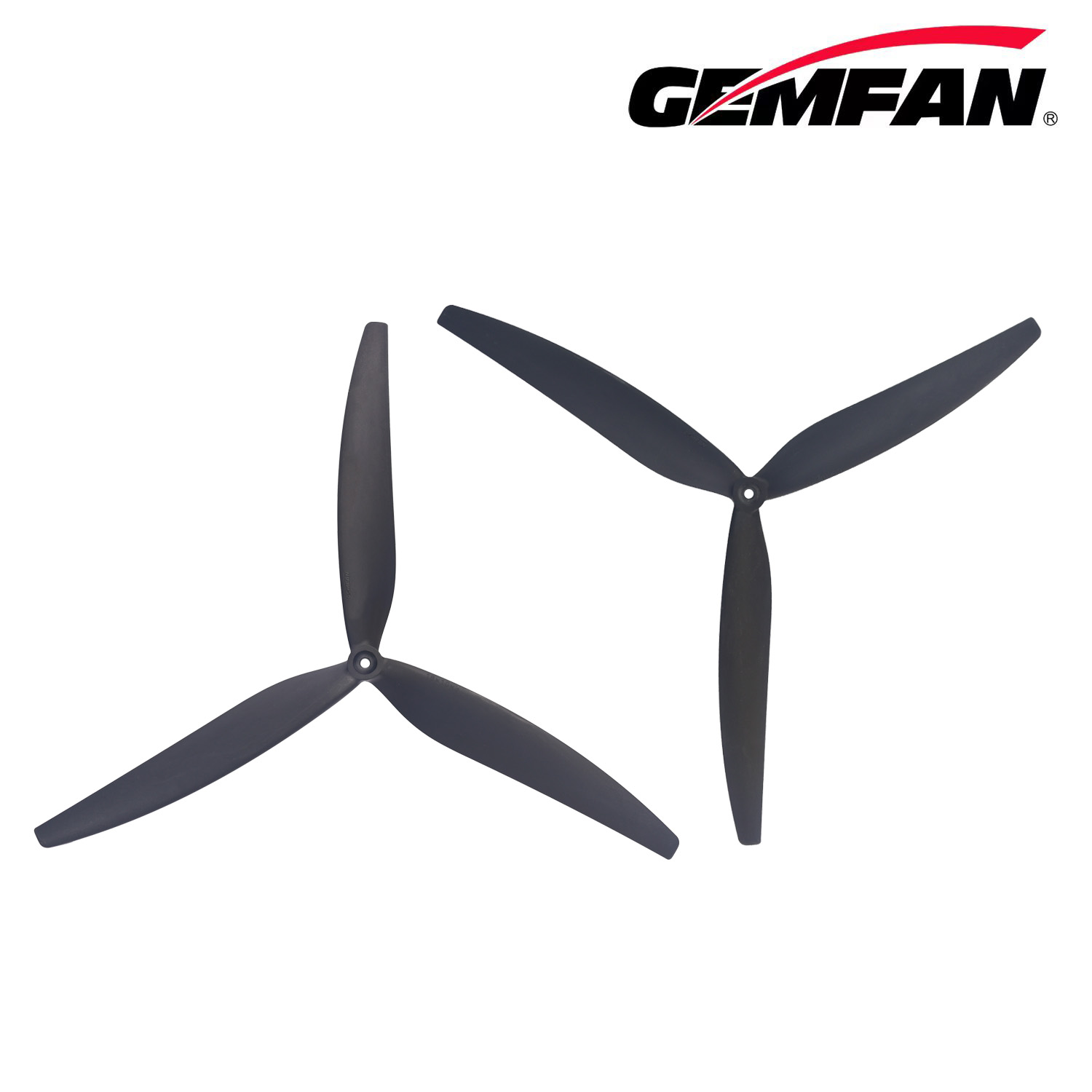
Material selection plays an equally critical role. The series utilizes glass fiber nylon construction, balancing structural rigidity with weight optimization. This material choice ensures blade dimensional stability under varying atmospheric conditions and centrifugal loading while maintaining manageable system weight—a crucial factor for overall flight efficiency.
The large-diameter design philosophy follows established aerodynamic principles: larger propellers move greater air mass at lower rotational speeds, fundamentally improving the thrust-to-power ratio. For the 18X10X3 configuration specifically, the 457.2mm (18-inch) diameter combined with a 10-inch pitch delivers sufficient takeoff thrust for quadcopters with 11-13kg takeoff weights on 1300mm wheelbase platforms. This specification is precisely calibrated for heavy mission payloads requiring robust propulsion reserves.
Power system integration represents another dimension of optimization. By generating required thrust at reduced RPM, these propellers decrease motor operating temperatures and electronic speed controller (ESC) electrical stress. This cascading benefit extends the operational lifespan of the entire propulsion chain—motors, ESCs, and battery systems—while simultaneously reducing noise pollution, a growing concern for industrial UAV operations in populated areas.
The series offers three distinct specifications: the 16X8X3 (406.4mm diameter, 84.9g) for 650mm-class platforms with 9-12kg takeoff weights; the 17X8X3 (431.8mm diameter, 100.5g) for 780mm wheelbase systems carrying 10-12kg; and the 18X10X3 (457.2mm diameter, 119.3g) for 1300mm heavy-lift platforms supporting 11-13kg configurations. Each variant maintains a 6mm center hole with adapter rings, ensuring compatibility with mainstream motor mounting standards.
Section 3: Deep Insights – Evolution Toward Heavy-Lift Efficiency
The trajectory of industrial UAV development points unmistakably toward payload expansion and operational duration extension. Aerial survey missions increasingly deploy high-resolution multispectral imaging systems; agricultural applications demand larger capacity spraying apparatus; infrastructure inspection requires specialized sensor packages—all driving upward pressure on propulsion system performance.
This trend creates a technological inflection point. Simply scaling motor power to compensate for increased weight produces diminishing returns due to battery capacity limitations and thermal management constraints. The more sustainable path involves optimizing the propulsion efficiency curve itself, extracting maximum thrust per unit of electrical energy consumed.
Three-blade large-diameter propellers represent this efficiency-first approach. By operating in a lower RPM range, these systems inhabit a more favorable position on the motor efficiency curve where electrical-to-mechanical conversion losses are minimized. The reduced rotational speed also mitigates aerodynamic efficiency degradation that occurs at blade-tip velocities approaching transonic conditions.
Environmental adaptability constitutes another emerging priority. Industrial UAVs operate in diverse atmospheric conditions—variable wind speeds, temperature extremes, and altitude variations. The three-blade architecture demonstrates superior wind resistance characteristics compared to two-blade configurations, maintaining flight stability in turbulent conditions that would otherwise compromise mission execution.
Standardization pressures are simultaneously reshaping the industry landscape. As UAV applications proliferate across sectors, demand grows for propulsion components that integrate seamlessly across multiple platform types. The 16-18 inch specification range with standardized mounting interfaces enables system integrators to develop modular platform architectures, reducing development cycles and inventory complexity.
A potential risk factor warrants attention: the industry’s rapid payload expansion may outpace propulsion technology development if efficiency optimization does not keep pace with weight increases. Platforms that simply add power without addressing fundamental efficiency will encounter hard limits imposed by battery energy density and thermal dissipation capacity.
Section 4: GEMFAN’s Industry Contribution – Engineering Precision in Propulsion
GEMFAN’s value proposition extends beyond component supply to encompass systematic propulsion engineering knowledge. The company’s 15-year accumulation in dynamic balance control technology—ensuring propeller assemblies meet strict rotational symmetry standards—directly translates to reduced vibration and extended component life in field operations.
The product development methodology reflects deep platform integration understanding. Rather than offering generic propeller options, GEMFAN has engineered specific configurations matched to defined wheelbase categories and takeoff weight ranges. The 18X10X3 variant’s calibration for 1300mm wheelbase platforms with 11-13kg takeoff capacity, paired with 5330 level motors, represents application-specific optimization rather than broad-spectrum design.
This precision matching enables system integrators and end-users to select propulsion components with confidence in performance outcomes. The recommended motor pairings—4720 500KV level for the 16X8X3, 5330 level for both 17X8X3 and 18X10X3—provide clear integration guidance, reducing trial-and-error testing and accelerating platform development timelines.
GEMFAN’s technical contribution includes addressing the load-balance equation: achieving equilibrium between power output capability and mechanical system stress. The 17X8X3 configuration exemplifies this approach, specifically designed for 10-12kg takeoff weights to optimize power delivery while minimizing motor RPM and heat generation, thereby reducing ESC load and improving overall propulsion system durability.
The company’s global market presence across over 60 countries provides practical validation of these engineering solutions across diverse operational environments and application scenarios—from power line inspection in North America to agricultural plant protection in Asia, infrastructure surveying in Europe to aerial photography in Australia. This geographic breadth offers empirical feedback that informs continuous product refinement.
Section 5: Conclusion + Industry Recommendations
The industrial UAV propulsion landscape is undergoing a fundamental shift from power-centric to efficiency-optimized architectures. As payload requirements continue expanding and operational endurance expectations rise, propulsion system design must prioritize thrust stability, energy conversion efficiency, and mechanical system longevity over raw power metrics alone.
Three-blade large-diameter propeller configurations represent a mature technical pathway addressing these priorities. For system integrators developing heavy-lift VTOL platforms, careful propulsion component selection matching specific wheelbase dimensions, takeoff weights, and motor specifications will yield measurable performance improvements in flight stability, operational duration, and system reliability.
Industry decision-makers should evaluate propulsion solutions based on holistic system efficiency rather than isolated component specifications. The interaction between propeller aerodynamics, motor operating points, ESC thermal performance, and battery discharge characteristics determines real-world mission capability.
Suppliers and platform developers are recommended to adopt standardized mounting interfaces and clearly defined integration specifications, facilitating modular architecture approaches that reduce development complexity and enable rapid platform variant development.
As the UAV industry matures toward broader commercial adoption, propulsion system refinement—though less visible than sensor technology or autonomy algorithms—remains foundational to operational success. Continued advancement in aerodynamic optimization, material science application, and precision manufacturing will determine which platforms achieve the reliability and economics required for sustained commercial viability.
http://www.gemfanhobby.com
Gemfan Hobby Co.,Ltd. -
AuthorPosts

- You must be logged in to reply to this topic.